

By Tom Hicks | October 5, 2026
Independent Journalism • No Talking Points.
EDITORIAL NOTE
There is no evidence that Jared Kushner personally stands to profit from the proposed Lukoil transaction discussed in this story. There is also no evidence that his diplomatic actions have directly affected the Israeli investments examined recently by CNN.
Those distinctions matter, because this story doesn’t need allegations we can’t prove. What we already know raises enough questions on its own.
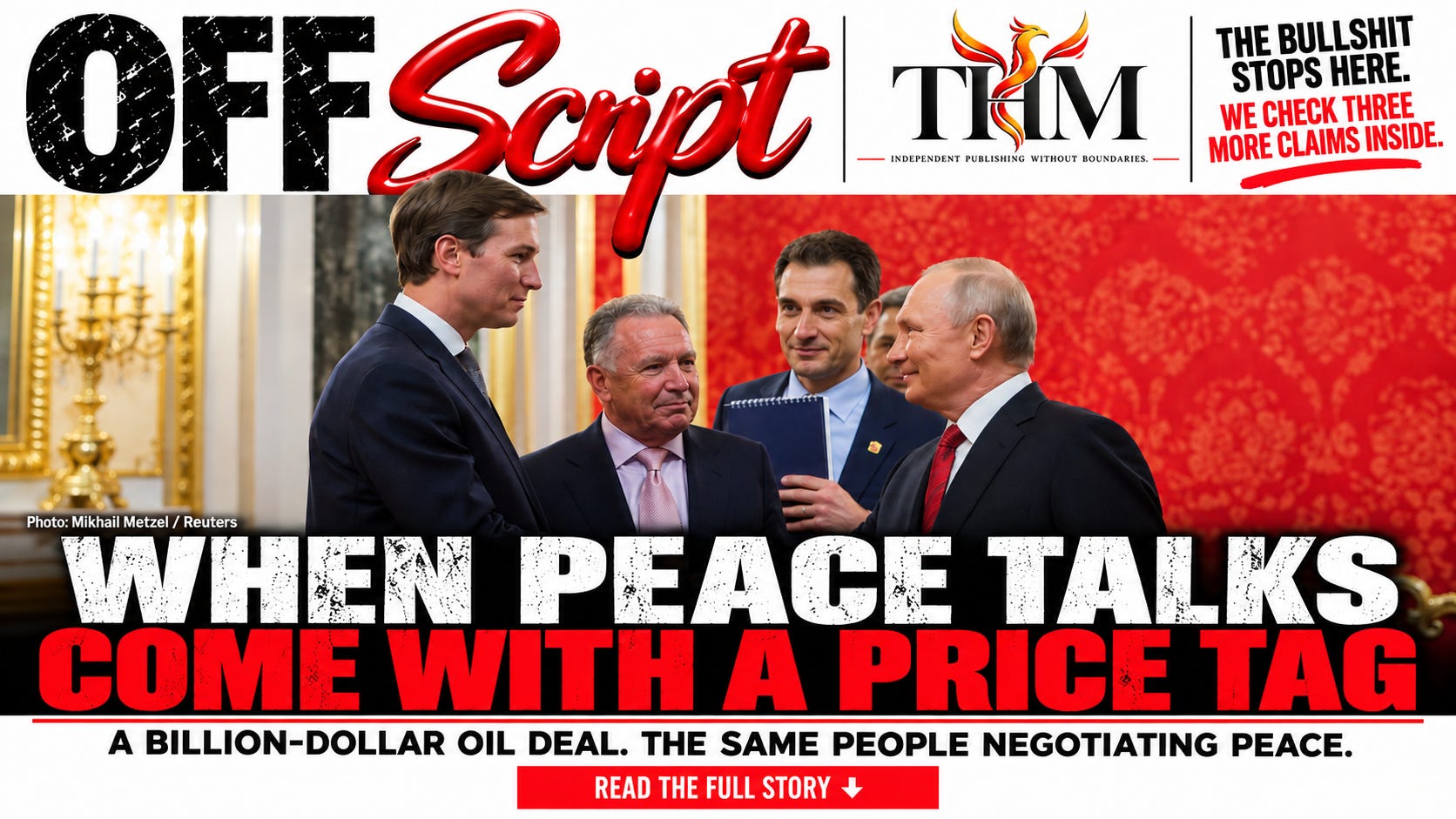
When Vladimir Putin’s government starts defending the ethics of an American peace negotiator, it’s probably worth asking exactly what everybody is negotiating.
That became a considerably more interesting question over the weekend, when we learned that the Trump administration’s negotiations with Russia over ending the war in Ukraine have expanded well beyond ceasefires, territory and security guarantees. According to The New York Times, as reported by Reuters, those talks now include discussion of a multibillion-dollar transaction involving international assets belonging to sanctioned Russian energy giant Lukoil.
The assets aren’t trivial. They include oil fields, refineries, and gas stations worldwide. The group pursuing them reportedly includes billionaire investor Todd Boehly, two Middle Eastern groups that have previously done business with Jared Kushner or Steve Witkoff’s family, and an arm of the United States government. Any transaction would require approval from Washington as well as the Kremlin.
That would already make this an unusual collision of diplomacy, sanctions policy and private business. Then you get to the part where Vladimir Putin reportedly raised the transaction himself.
During a September 5 meeting at the Kremlin with Kushner and Witkoff, Putin brought up completing the Lukoil deal as a way of demonstrating that Russians could once again do business with the United States. In other words, a commercial transaction potentially worth billions wasn’t merely happening somewhere in the background while peace negotiations continued. According to the reporting, the president of Russia put it on the table with the Americans negotiating over Ukraine.
Maybe there’s a perfectly legitimate explanation for every piece of this.
I’d still like to see the guardrails.
SUPPORT INDEPENDENT WORK
If Off Script helps you understand what happened instead of merely telling you whom to be angry at, subscribe.
It’s free — or help fund the research and tools we use every day.
THE PROBLEM ISN’T A BAG OF CASH
There is an easy version of this story to write, and it’s probably the version that will get passed around social media: Kushner, Russia, oil, billions of dollars, draw your own conclusion.
We’re not going to do that.
Nothing in the reporting establishes that Kushner has a personal financial stake in the proposed Lukoil acquisition. Nothing establishes that Witkoff does either. There is no evidence here of a payoff, kickback, or quid pro quo, and turning a complicated ethics story into an accusation of corruption that the evidence doesn’t support would make the story weaker rather than stronger.
What the reporting does establish is an increasingly blurry intersection between American foreign policy and the private commercial relationships surrounding some of the people conducting it. Peace negotiations with Russia are taking place while sanctions policy, government approval of a major Russian oil transaction, private investors, and business relationships connected to the negotiators or their families are moving through the same landscape.
Conflict-of-interest rules exist precisely because corruption isn’t the only thing that can damage public trust. The public shouldn’t have to prove that somebody secretly made money before it’s allowed to ask whether the people exercising government power have financial interests, relationships or obligations that overlap with the decisions they’re helping make.
And with Kushner, Russia isn’t the only place that question has surfaced.
THERE’S ANOTHER DEAL ON THE OTHER SIDE OF THE WORLD
A few days before the Lukoil story broke, CNN published an investigation into Kushner’s private business interests while he has been participating in American diplomacy in the Middle East.
Kushner owns Affinity Partners, the private equity firm he founded after leaving the first Trump administration. Affinity is the largest shareholder in Phoenix Financial, a major Israeli financial company. CNN’s investigation identified nine companies in Phoenix’s portfolio that provide equipment to the Israeli military, including companies making equipment used in Gaza.
Affinity doesn’t directly own those companies, which is an important distinction. It owns part of Phoenix, and Phoenix makes its own investment decisions. Kushner’s attorney told CNN that Kushner isn’t involved in Phoenix’s decisions about where to invest, isn’t on its board, and has never held a management role at the company. CNN also found no evidence that Kushner directly influenced Phoenix’s investment decisions in the military-linked companies.
But Affinity’s Phoenix investment has certainly been lucrative. The larger point isn’t that Kushner controls those individual investments. It’s that his private investment company has a substantial financial interest in a major Israeli institution while he has simultaneously participated in American diplomacy involving Israel and Gaza.
Again, none of that establishes corruption. It establishes something more basic and much easier to demonstrate: Kushner has substantial private financial interests in parts of the world where he is also exercising substantial public influence.
That should make transparency more important, not less.
SO WHAT EXACTLY ARE THE RULES?
For much of Trump’s second term, Kushner occupied a peculiar position. He participated in high-level diplomacy without holding the sort of conventional government job that would make the ethics requirements surrounding him easy for the public to understand.
That changed, at least formally, on February 19, when Trump announced Kushner’s appointment as Special Envoy for Peace. Citizens for Responsibility and Ethics in Washington subsequently argued that the appointment triggered federal financial-disclosure requirements and asked the White House to obtain Kushner’s disclosure within the required timeframe.
In its letter to White House counsel, CREW cited the applicable federal regulation and pointed out that Steve Witkoff, who had also been appointed a special envoy, filed a public financial disclosure report.
CREW isn’t a neutral referee here. It’s an ethics watchdog organization that has been sharply critical of Kushner and the Trump administration, and its legal argument is its own. But the underlying question shouldn’t require anybody to share CREW’s politics.
If someone is representing the United States in negotiations involving Russia, Ukraine, Israel, Gaza and Iran while also owning a private investment company with extensive international interests, what financial disclosures should the public get to see? What conflicts have been reviewed? Who performs that review? When is recusal required? What happens when a foreign government puts a commercial transaction involving people connected to the American negotiators into the diplomatic discussion itself?
Those aren’t gotcha questions. They’re the boring questions government ethics rules are supposed to answer before the interesting questions become necessary.
AND THEN THE KREMLIN SHOWED UP
As scrutiny of Kushner’s financial relationships intensified, Kirill Dmitriev decided to help.
Dmitriev is Putin’s special envoy for investment and economic cooperation and head of Russia’s sovereign wealth fund. After Kushner pushed back publicly against the CNN reporting, Dmitriev defended him, calling Kushner a “Peacemaker” and blaming criticism of him on “warmongers.”
The Kremlin defending Kushner doesn’t prove anything about Kushner. Russia has its own interests and its own reasons for praising an American negotiator with whom it wants to do business. Treating Dmitriev’s intervention as evidence of wrongdoing would be silly.
Treating it as irrelevant would be equally silly.
Russia has made little secret of the fact that it sees economic cooperation as part of the larger relationship it wants to rebuild with Washington. Just days before the Lukoil story broke, Reuters reported that Dmitriev met U.S. officials in Washington to discuss both ending the Ukraine war and possible U.S.-Russia energy initiatives after the war.
The proposed Lukoil transaction fits comfortably into that strategy. Putin reportedly described the deal as a way to show Russians that business with the United States could resume, and the transaction would require decisions by the very governments whose representatives are negotiating the future of Ukraine.
That changes the context. We’re no longer talking about an investment portfolio sitting several degrees removed from foreign policy. We’re talking about business being discussed as part of the diplomatic relationship itself.
And business absolutely can be part of diplomacy. Governments use trade, sanctions, investment, and reconstruction agreements all the time to create incentives for peace. There’s nothing inherently suspicious about economic cooperation being included in negotiations with Russia.
The trouble comes when the people representing the United States also move through a private financial world populated by some of the same governments, investors and business interests touched by those negotiations.
At that point, “Trust us” isn’t much of an ethics policy.
SHOW US THE WALL
Maybe Kushner has kept his public and private roles completely separate. Maybe every potential conflict has been reviewed. Maybe there are ethics agreements and recusals that draw bright lines around what he can and cannot touch.
If that’s the case, this should be an extraordinarily easy controversy to settle.
Explain what financial disclosure requirements apply to Kushner as Special Envoy for Peace and whether he has complied with them. Explain what ethics review occurs before he participates in negotiations affecting countries or businesses connected to Affinity Partners. Explain whether the Lukoil transaction created any recusal question for Kushner or Witkoff. Explain who inside the government is responsible for deciding where those lines are.
That’s the frustrating thing about this story. Everybody keeps looking for the dramatic revelation when the unanswered administrative questions are interesting enough.
We don’t need an email saying somebody wanted to get rich. We don’t need a secret bank account. We don’t need a photograph of Jared Kushner leaving the Kremlin carrying a sack with a dollar sign painted on it.
We need to know how the government prevents private interests from influencing public decisions when the same person operates in both worlds.
Because those worlds are getting awfully close together.
Putin discussed a multibillion-dollar oil transaction with the Americans negotiating over Ukraine. The consortium pursuing the assets reportedly includes investors with previous business connections to Kushner or Witkoff’s family. The transaction requires government approval. Kushner simultaneously owns an investment firm with major interests in another region where he conducts American diplomacy. And now a senior Kremlin official has decided that defending Kushner publicly is useful to Russia.
None of that proves Jared Kushner is corrupt.
It does make one question increasingly difficult to avoid:
Who is watching the people making the deals?
💩 THE BULLSHIT DETECTOR
CLAIM 1
Donald Trump said he had repeatedly predicted eliminating Iran’s nuclear threat would take “4–6 weeks,” but that he accomplished it “in one night.”
BULLSHIT
💩💩💩💩💩 5/5
WHY
Trump did repeatedly predict a four-to-six-week timeline when the war began. The problem is that he was talking about how long the war would last, not promising that Iran’s nuclear threat would be eliminated within that period. PolitiFact checked Trump’s earlier statements and found that when it asked the White House for previous examples in which Trump had made the distinction he now claims he made, the White House didn’t provide any.
Seven months later, Trump has rewritten his original prediction to make it sound as though he met it.
CLAIM 2
At Saturday’s Ohio rally, Trump said, “We have almost no inflation.”
BULLSHIT
💩💩💩💩 4/5
WHY
Almost no inflation would be wonderful. It also isn’t what the numbers say.
Year-over-year inflation was 3.4 percent in August, the latest available reading, compared with 3 percent when Trump began his second term. That’s also well above the Federal Reserve’s 2 percent target. Inflation isn’t remotely at the levels Americans experienced several years ago, but “almost no inflation” isn’t an accurate description of what’s happening now. PolitiFact checked the claim following Saturday’s rally.
CLAIM 3
At the same Ohio rally, Sen. Jon Husted said former Sen. Sherrod Brown gave people in the country illegally “your Social Security money and free healthcare and COVID checks.”
BULLSHIT
💩💩💩💩💩 5/5
WHY
This one takes three separate votes and turns them into something they weren’t.
Brown’s 2007 Social Security vote involved immigrants who had later obtained legal status, not benefits for people living here illegally. His 2013 healthcare vote didn’t make undocumented immigrants eligible for federally subsidized healthcare; federal law already barred them from Medicaid, CHIP, and Affordable Care Act subsidies. And the 2021 American Rescue Plan required a valid Social Security number to receive the $1,400 stimulus payment, excluding people living in the country illegally.
That’s three claims bundled into one sentence, and PolitiFact’s examination of the underlying votes found that all three distort what the legislation actually did.
Bullshit Detector available at the Tom Hicks Media Store. Because everybody could use a little less bullshit in their life.
MORE FROM TOM HICKS MEDIA
Blind Spot
The stories hiding underneath the headlines.
Chart Collision
Music, memories and the stories behind the songs.
Rabbit Ears Classic TV
Classic television without pretending everything used to be better.
The Backlot Ghost
Movies, memories and the stories Hollywood left behind.
Panic Room Sports
Everyone reacts. We’ll check the tape first.
Lotus Purrspective
Life, humans and other questionable decisions, according to Lotus.
What the Hell?
True stories that sound completely made up.
You’re not going to believe this shit.
BUY ME A CUP OF TEA
Independent reporting isn’t free to produce, even when it’s free to read.
If you value Off Script and want to help pay for the research, subscriptions, and tools behind it, you can buy me a cup of tea.
ONE QUESTION BEFORE YOU GO
If someone is negotiating for the United States while maintaining major private business interests overseas, what level of financial disclosure should the public be entitled to see?
#JaredKushner #Russia #Ukraine #Lukoil #TrumpAdministration #GovernmentEthics #ForeignPolicy #OffScript #TomHicksMedia