

Editorial Note
I’ve always been suspicious as hell of government agencies that suddenly go dead silent on you.
I don’t care if they’re run by Republicans, Democrats, or a goddamn committee of golden retrievers. If an agency’s whole job is to make decisions, then make the decision. Say yes. Say no. Tell somebody “you don’t have a case, go home.” Fine. I can live with fine.
Just don’t vanish behind the curtain and act like the lights are still on.
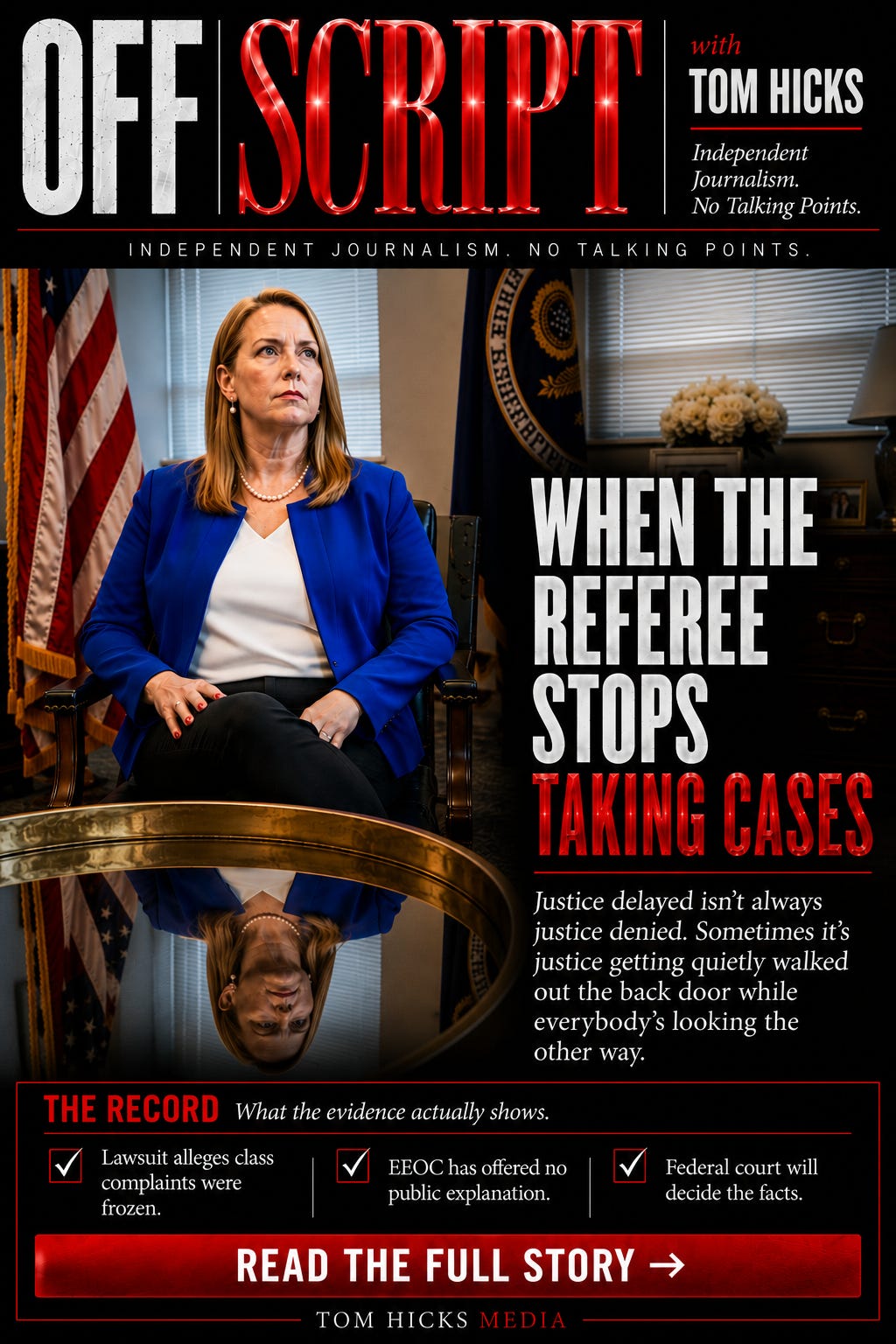
That’s why a lawsuit filed this week against the Equal Employment Opportunity Commission stopped me cold. The allegations are serious, and once you see the details underneath them, this stops being an abstract story about paperwork and turns into something a lot uglier.
Most people have never had to deal with the EEOC. Good. Keep it that way if you can.
The job’s simple enough on paper. Somebody thinks they got screwed at work over race, sex, religion, disability, age, whatever protected category applies. The EEOC investigates. Sometimes they toss it. Sometimes they broker a fix. Sometimes it lands in court. That’s the system Congress built.
This lawsuit isn’t saying the EEOC made bad calls. Hell, that’d almost be refreshing at this point.
It’s saying the agency mostly stopped making calls at all, on every federal-sector class complaint in the pipeline, and it’s saying it with names attached this time.
The suit was filed Tuesday by the American Federation of Government Employees along with two correctional officers, Deanna Chelette and Alexzandria Boyd, who work at the Federal Correctional Complex in Pollock, Louisiana. (Federal News Network)
Enjoying Off Script?
If you appreciate evidence over talking points, I’d love to have you as a subscriber. Every subscriber receives a free copy of The Bullshit Detector. Prefer to buy it instead? It’s also available for $4.95 through the Tom Hicks Media Store.
Here’s where it stops being abstract. Chelette and Boyd have a certified class complaint against the Federal Bureau of Prisons alleging that management let male inmates subject female staff to sexual harassment, including rape threats, unwanted touching, and indecent exposure. An administrative judge, Erania Ebron, certified that class back in March of 2025. The case was moving. Then in December, Ebron issued a notice pausing it indefinitely, no explanation given, and it’s sat there ever since. The complaint estimates at least 182 women could be part of that class. (AP via ABC News)
Read that again. A judge already said this case was strong enough to certify. Then somebody above her pay grade froze it anyway, and the women involved have spent seven months not knowing if anybody’s still working on it. At the same time, the lawsuit says some of them remain at risk of the same harassment continuing in the meantime.
If the allegations are true, that’s not a paperwork backlog. That’s a decision dressed up to look like the absence of one.
And it’s not just this one case. The plaintiffs’ attorneys say at least five other class complaints are stalled the same way, including cases against the FBI and the Department of Defense. This isn’t one office having a rough year. This is a pattern, agencywide, and it’s been running since late last year with nobody at the EEOC saying a word about it publicly. (Federal News Network)
Joseph Sellers, who co-chairs the law firm representing the plaintiffs, put it plainly, saying the freeze looks like an attempt to “undermine the ability of employees to protect” their rights. Those are strong words, and whether he’s right is exactly what this lawsuit is going to test. That’s why facts matter more than assumptions, and why the EEOC deserves the same due process we’re talking about for everyone else.
Now here’s the part that turns this whole thing from a mystery into a story with an actual explanation.
Since taking over as EEOC chair last year, Andrea Lucas hasn’t been shy about what she wants the agency to look like. She’s shifted enforcement away from systemic discrimination cases. She’s redirected resources toward investigating employer DEI programs, on the theory that race- and sex-conscious workplace initiatives might themselves violate civil rights law. She’s dropped or walked away from cases involving transgender workers. She calls it an “even-handed” and “colorblind” approach to workplace civil rights. Critics call it something closer to gutting the agency’s enforcement teeth from the inside. (US News/AP)
You don’t need a law degree to notice that the alleged freeze on systemic discrimination cases is occurring at the same time the administration has been openly reprioritizing the EEOC’s enforcement agenda. That timing may prove to be coincidence. It may not. That’s one of the questions this lawsuit is likely to explore.
Maybe the EEOC has a perfectly reasonable explanation. Maybe it doesn’t. That’s why lawsuits exist. Judges are supposed to sort evidence from speculation, and that’s exactly what this one is now positioned to do.
Now let’s be crystal clear before somebody decides to light their hair on fire in the comments.
These are allegations.
The suit was just filed days ago, ink barely dry.
A judge is going to be the one who decides what’s actually true here, not me, not Twitter, not your uncle who forwards you news from three websites deep in a Facebook rabbit hole.
That’s usually where people stop thinking. Case filed, somebody’s mad, next story.
I think that’s exactly where it gets interesting.
Because if this is true, we’re not talking about employment law anymore. We’re talking about a government agency that might have found the cleanest way in the world to dodge controversy while still getting the outcome it wants.
Don’t make the call. You don’t have to rule against anybody. You don’t have to rule for anybody either. You just let the clock do your dirty work.
And Christ, the clock never loses.
Witnesses retire. Managers get transferred three states away. Employees quit because they can’t wait around forever. Memories go soft. Evidence walks off or just gets harder and harder to find. People run out of hope, because they’ve got mortgages, they’ve got kids, they’ve got a life to live, and eventually plenty of them just walk away, worn down by a government office that won’t pick up the goddamn phone.
That’s not justice. It’s exhaustion wearing a badge.
And here’s what actually pisses me off about it.
If Congress passed a law tomorrow flat-out killing federal employee class discrimination complaints, we’d have hearings for weeks. Reporters camped outside. Advocacy groups screaming bloody murder. Cable news panels arguing until the collective national IQ dropped twenty points overnight, easy.
Everybody in the country would know exactly what happened.
But an agency just quietly stops processing cases, no announcement, no policy memo, no press conference, and the end result can look damn near identical while getting a fraction of the attention. Maybe less.
That’s the part that should keep you up at night. Not because every complaint’s a winner. It sure as hell isn’t. Not because every federal employee walking in the door is automatically right, because they’re not; that’s what investigations are for.
It should bother you because every one of them deserves an answer. The 182 women in that Louisiana case deserve one. The people in those FBI and DOD cases deserve one too.
Weak case? Tell them it’s weak. Strong case? Move it. Changed your priorities? Then say so out loud, where people can see it, instead of hiding behind silence and hoping nobody notices what got dropped.
Trust in institutions doesn’t die from some big scandal, some smoking gun on the front page. It dies slow, one unanswered phone call at a time.
Here’s the part I keep circling back to, the part that won’t let go of me.
I’ve watched government long enough to know bureaucracies have a favorite move when they don’t want to deal with something. It’s not corruption, not exactly. It’s simpler and dumber than that.
Delay.
Sometimes that’s innocent. They’re understaffed, they’re buried, they’ve got more work than hands to do it. Fair enough, I get it.
But delay does something else too, whether anybody plans it that way or not. It moves the power from one side of the table to the other.
If you’re the government, sitting on your hands doesn’t cost you a damn thing. Lights stay on. Paychecks clear. The lawyers show up again Monday morning, same as always.
The person on the other side of that desk doesn’t get that deal. They’re paying an attorney out of pocket. They’re reliving whatever happened to them every single time another form shows up in the mailbox. They’re lying awake wondering if a human being has even looked at their file yet, or if it’s just sitting in a drawer somewhere gathering dust next to a thousand others just like it.
Sooner or later, a lot of people decide they don’t have another year of this left in them.
The system never had to say no to their face. It just waited until they stopped asking.
That’s why this story’s bigger than the EEOC, bigger than one lawsuit, bigger than one agency having a bad year.
Every institution in this country runs on the same unspoken deal with the people it serves. People will accept losing. They’ll even accept a decision they think is flat wrong, so long as somebody actually made it. What they won’t swallow forever is the feeling that nobody’s even bothering to decide anymore.
You see it everywhere once you start looking.
Veterans waiting on benefits that take longer than the wars did. Immigration cases dragging on for years. Social Security backlogs stacked to the ceiling. Court dockets so jammed that by the time justice shows up it doesn’t even matter anymore.
None of it’s identical, but it all leaves the same rotten taste. The government isn’t telling you no. It’s telling you “maybe someday,” and someday’s got a funny way of never arriving.
That’s not a functioning system. That’s a waiting room with the lights left on. And waiting rooms have a nasty habit of turning permanent if nobody stands up and says enough’s enough.
Maybe the EEOC’s got a defense for all of this, and it’ll come out once the case gets rolling. Maybe Lucas’s overhaul has nothing to do with the freeze at all. That’s exactly what courts are for, so let the damn thing play out.
Evidence matters. Facts matter. Due process matters, and not just for the people bringing the complaints. It protects the agency too, if it’s actually got a defense worth hearing.
That’s the difference between journalism and just screaming into a megaphone. I’m not here to convict the EEOC on Twitter before a single hearing happens. I’m here asking whether a civil rights agency is still doing the job Congress handed it, or whether it’s found a quiet way to stop doing that job without ever having to admit it out loud.
If the answer’s yes, great, I’ll say so.
If the answer’s no, 182 women in Louisiana and however many more in those other frozen cases deserve to know why.
That’s what accountability actually looks like. Not assuming guilt walking in the door. Not assuming innocence either. Just asking the hard questions until somebody with a real answer finally shows up to give one.
If there’s one thing I’ve picked up over the years, it’s this. Government almost never loses your trust in one big dramatic blowup. It bleeds out one unanswered question at a time.
One Question Before You Go
You ever deal with a government agency where the real problem wasn’t the answer you got, but the fact that nobody ever bothered giving you one at all?
Tell me about it in the comments. I mean it, I want to hear it.
THE RECORD
Here’s what the actual evidence shows, no spin.
The American Federation of Government Employees and two federal correctional officers, Deanna Chelette and Alexzandria Boyd, sued the EEOC on Tuesday, alleging the agency froze federal-sector class discrimination complaint processing since late last year, affecting theirs and at least five other class cases, including ones against the FBI and Department of Defense. Their own case, a certified class complaint alleging sexual harassment of female staff by inmates at a Louisiana federal prison, was certified by Administrative Judge Erania Ebron in March 2025 and paused in December with no public explanation. The complaint estimates the class could include at least 182 women. The EEOC has not publicly explained the alleged suspension, and the Justice Department declined comment on the pending litigation. Since 2025, EEOC Chair Andrea Lucas has reprioritized the agency’s enforcement agenda, placing greater emphasis on investigations involving employer DEI programs while reducing emphasis on some categories of systemic discrimination enforcement. The lawsuit does not allege that Lucas personally ordered the freeze, and that question remains unresolved.
The Bullshit Detector
Next time somebody tells you, “Nothing’s changed,” ask them one damn question.
Is the law the same, or is the process?
Half the time the biggest changes don’t come because Congress passes a new law. They come because the machinery quietly stops moving while everybody’s busy watching something else.
Worth remembering.
More from Tom Hicks Media
Panic Room Sports
Football without the hot takes. We separate meaningful camp news from preseason noise and tell you what actually matters.
Tom’s Number Ones
Every day we revisit a different Billboard No. 1 from the exact week it topped the charts, with the stories behind the songs and the memories they still carry.
Lotus Purrspective
The world according to my cat, who remains convinced humans are fascinating, lovable, and just a little ridiculous.
All are free to subscribe.
Buy Me a Cup of Tea
If this kind of journalism is worth something to you, buy me a virtual cup of tea. Every contribution helps keep Off Script independent, reader-funded, and free of corporate sponsors, political parties, and anybody else’s marching orders.
Thanks for sticking around.
— Tom
#OffScript #CivilRights #EEOC #GovernmentAccountability #FederalEmployees #DueProcess #IndependentJournalism #TomHicksMedia