

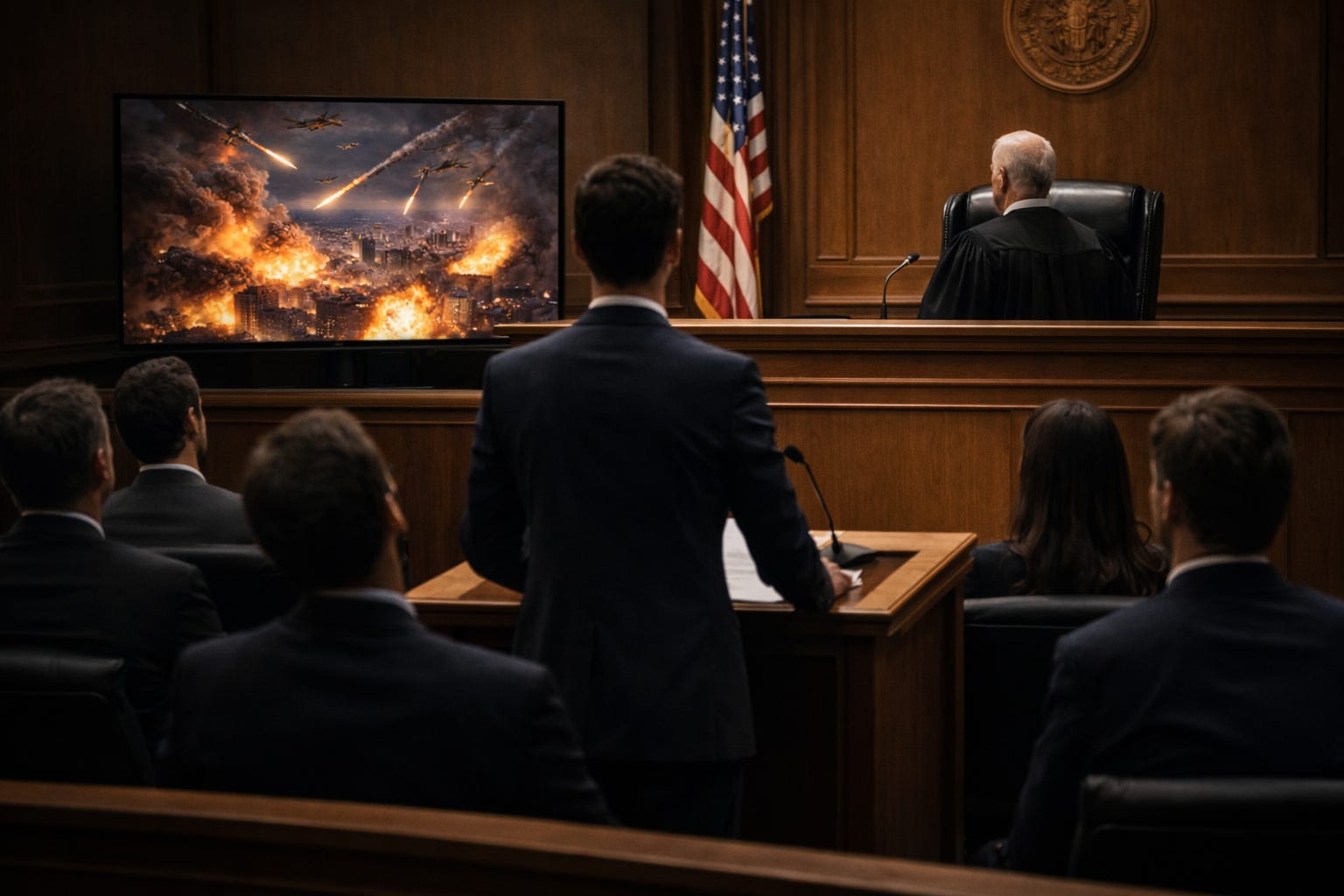
The missiles get the cameras. They always do.
Maps. Sirens. Breaking banners screaming about escalation. Panels of retired generals pointing at glowing red arrows like they’re coaching a Super Bowl play instead of discussing whether the planet might accidentally slide into a regional war.
Meanwhile, while everyone’s eyes are glued to explosions overseas, something a lot quieter—and arguably more consequential for Americans sitting at their kitchen tables—has been happening in courtrooms and legal filings back here at home. While the public has been doom-scrolling war coverage, the federal government has been advancing two legal arguments that, taken together, amount to a breathtaking constitutional stress test.
First, the Justice Department has argued in federal court that courts cannot compel the executive branch to release certain Epstein-related records.
Second, the administration has been pushing an executive order attempting to reshape federal election rules, triggering legal battles over whether a president can unilaterally change how Americans vote.
Different cases. Different headlines.
Same underlying question.
Who the hell is the government actually accountable to anymore?
And before anyone says, “calm down, that’s just routine legal maneuvering,” let me translate that phrase from Washingtonese into plain English. “Routine legal maneuvering” in D.C. usually means someone is trying to rearrange the constitutional furniture while the public is staring at a shiny object.
Right now, that shiny object happens to be bombs.
While everyone is watching the explosions like it’s the world’s most depressing fireworks show, the executive branch appears to be quietly testing how much power it can scoop up with a legal shovel the size of a fucking snowplow.
Quick favor before we keep going
If you want writing that digs into the stories happening behind the headlines instead of just repeating them, hit the Subscribe button and join the Bastard’s growing band of informed troublemakers. Independent journalism survives because readers decide it matters.
Now let’s get into the part that the cable panels aren’t talking about.
Opening Shot: The Perfect Distraction
War coverage has a gravitational pull. It sucks up every inch of oxygen in the news cycle.
Cable networks love it because war is visually dramatic. Social media loves it because it’s emotionally combustible. Politicians love it because nothing buries domestic controversies faster than a few thousand pounds of ordnance falling somewhere else on Earth.
It’s the oldest political trick in the book: when bombs start flying, nobody notices what’s happening in the paperwork.
And make no mistake—right now the paperwork is where the real shit is happening.
Because buried in legal filings and executive actions are two arguments that, taken together, sketch out a vision of government power that should make anyone who vaguely remembers eighth-grade civics sit upright and mutter, “Hold on… that doesn’t sound right.”
Reality Mechanism: The Epstein “Trust Us” Doctrine
Let’s start with the Epstein files.
Jeffrey Epstein—the financier-turned-serial predator whose social circle included billionaires, politicians, celebrities, and a suspicious number of people who would very much prefer their names never appear in a public document dump.
For years, the public has been asking a simple question:
Who else was involved?
Now the Justice Department’s legal position—boiled down to its bluntest form—amounts to something dangerously close to this:
The executive branch gets to decide what materials exist and whether anyone gets to see them.
Not Congress.
Not the courts.
Possibly not even the Supreme Court.
If that sounds insane, that’s because it’s skating dangerously close to a constitutional principle I like to call the “Trust Us, Bro” Doctrine.
The logic is breathtaking in its simplicity. The government investigates something. The government decides which documents exist. The government decides which documents the public gets to see. And if anyone pushes back, the government’s lawyers stroll into court and argue that forcing disclosure would violate executive authority.
Which raises a fun little question.
If the executive branch gets the final say on what evidence the public is allowed to see, then how exactly is accountability supposed to work?
Because that sounds less like transparency and more like a locked filing cabinet labeled “Nothing To See Here, Fuck Off.”
It’s the bureaucratic equivalent of a teenager standing in front of a broken lamp saying, “Don’t worry about it, I handled it.” Except that the teenager in this scenario is the federal government, and the lamp is public accountability.
When the executive branch starts arguing that courts can’t compel transparency, what they’re really saying is:
“We investigated ourselves and—shockingly—we found nothing you’re allowed to look at.”
That’s not oversight. That’s a magician pulling a velvet curtain over the filing cabinet and hoping nobody notices the rabbit screaming inside.
The Second Quiet Bomb: Elections by Executive Order
Now let’s talk about the other legal fight quietly grinding its way through the courts while everyone is busy arguing about missiles and airspace.
The administration issued an executive order attempting to impose new federal voting rules—requirements around voter eligibility and ballot procedures that would reshape how elections are administered across the country.
Courts have already blocked major parts of it.
Which is the judicial branch’s polite way of saying:
“Hold the fuck on, that’s not how this works.”
Judges appointed by both parties have raised serious constitutional concerns about whether a president can unilaterally dictate election procedures that traditionally fall under congressional legislation and state control.
In other words, we’re watching a slow-motion legal collision between two branches of government.
And here’s the thing that should make your eyebrows climb into your hairline.
If the executive branch wins this fight, it establishes the precedent that presidents can reshape federal election mechanics through executive authority.
That’s not a minor administrative tweak.
That’s the kind of power shift historians eventually write entire chapters about—usually with titles like “constitutional crisis,” “executive overreach,” or “how the hell did we let that happen.”
Who Benefits?
Whenever you see a government pushing the boundaries of its authority, the first question to ask is painfully simple.
Who benefits if this works?
If the Epstein documents remain sealed behind layers of executive privilege, the beneficiaries are obvious: anyone whose name might appear in those records and would prefer the public never find out.
If the executive branch gains the ability to impose election rules through presidential authority, the beneficiaries are also obvious: whichever administration happens to be in power when those rules are written.
Power consolidates upward.
Accountability drifts downward.
Think of it like a giant political gravity well. Authority gets sucked upward toward the executive branch while responsibility gets kicked downward toward the public like a dented soda can rolling across a parking lot.
And if you’re wondering whether that’s healthy for a democracy, the answer is about as obvious as a raccoon trying to pass itself off as a house cat.
Gaslight Zone
This is the part where officials will inevitably tell you these legal arguments are routine.
Technical.
Procedural.
Nothing to see here.
Washington has a long tradition of insisting something is “nothing to worry about” right up until it turns out to be very much something to worry about.
It’s the government equivalent of someone saying “this won’t hurt” right before handing you a chainsaw and asking you to hold still.
They’ll say the Epstein dispute is about protecting investigative integrity. They’ll frame the election executive order as an administrative effort to standardize procedures.
But when you step back and look at the bigger picture, something else becomes painfully clear.
The executive branch is simultaneously testing two boundaries that underpin democratic accountability:
information control and election control.
If the government can decide what evidence the public is allowed to see and how elections are conducted, checks and balances start looking less like guardrails and more like decorative landscaping.
Democracy Damage Report
Here’s the part that should keep people awake at night.
Neither of these stories, on their own, necessarily breaks the constitutional system tomorrow morning.
But together they represent something more dangerous:
precedent creep.
Precedent creep is how democracies slowly wander into trouble without realizing it. Nobody wakes up one morning and declares, “Today we’re dismantling accountability.” Instead, it happens one legal argument at a time, one executive order at a time, one quiet little court filing that sounds technical but smells like bullshit if you sniff it long enough.
Every administration pushes boundaries a little further than the last one. Every legal victory becomes the starting point for the next expansion of authority.
Eventually, you wake up and realize the center of gravity in American government has shifted dramatically—and nobody remembers exactly when it happened.
Because the change didn’t arrive with a bang.
It arrived in court filings.
Verdict
While everyone was watching the bombs, two quiet legal battles revealed something important about how power actually moves in Washington.
Not through dramatic speeches.
Not through televised votes.
Through lawyers testing the limits of what they can get away with, while the public is distracted.
But the real power plays almost never come with sirens and dramatic music. They happen in the dull, fluorescent-lit corners of government where lawyers argue about authority while the rest of the country is staring somewhere else.
And right now, in those dull corners, the executive branch appears to be asking a very simple question:
How much power can we grab before someone notices?
The answer depends on whether the courts push back—and whether the public stops staring at the explosions long enough to realize some seriously consequential shit is happening in the fine print.
Because if nobody notices the power grab while the bombs are falling, the government might conclude it can get away with it again.
That’s how democracies slowly get nudged off the rails.
Not with a bang.
But with a legal brief and a quiet “trust us” that smells like absolute fucking nonsense.
💣 TRUTH BOMB
“If the government controls what evidence you can see and how elections are run, accountability stops being a right and starts becoming a suggestion.”
— The Unredacted Bastard
Support Independent Journalism
This publication is reader-supported. No corporate overlords. No billionaire sugar daddies. Just a retired journalist, a keyboard, and a very low tolerance for political bullshit.
If you value independent voices willing to call this stuff out before it becomes tomorrow’s constitutional crisis, consider upgrading your subscription.
Paid supporters help keep the Bastard caffeinated, ornery, and fully operational.
Buy Me A Coffee ☕
If this article made you laugh, think, or mutter “holy shit” into your phone, you can throw a little fuel into the Bastard’s caffeine engine.
Because democracy may run on institutions…
…but Bastard journalism runs on coffee and righteous anger.
From the Bastard’s Feline Intelligence Division
If you enjoy sharp political commentary with fewer f-bombs and more whiskers, check out Lotus Purrspective, where a judgmental tuxedo cat examines human stupidity with the calm authority of someone who has never once paid taxes yet somehow understands democracy better than half of Congress.
Look for Lotus’s latest dispatch right here on Substack.
#Like #Share #Subscribe #TheUnredactedBastard #ExecutivePower #EpsteinFiles #ElectionLaw #DemocracyWatch