

Tom Hicks | October 11, 2026 | THE ELECTION BEFORE THE ELECTION — PART TWO
EDITORIAL NOTE
This is the second installment of The Election Before the Election, our special Blind Spot series examining what happens before the ballots are counted. We’re making the entire series available to everyone because understanding how our elections work shouldn’t depend on whether somebody can afford a subscription.
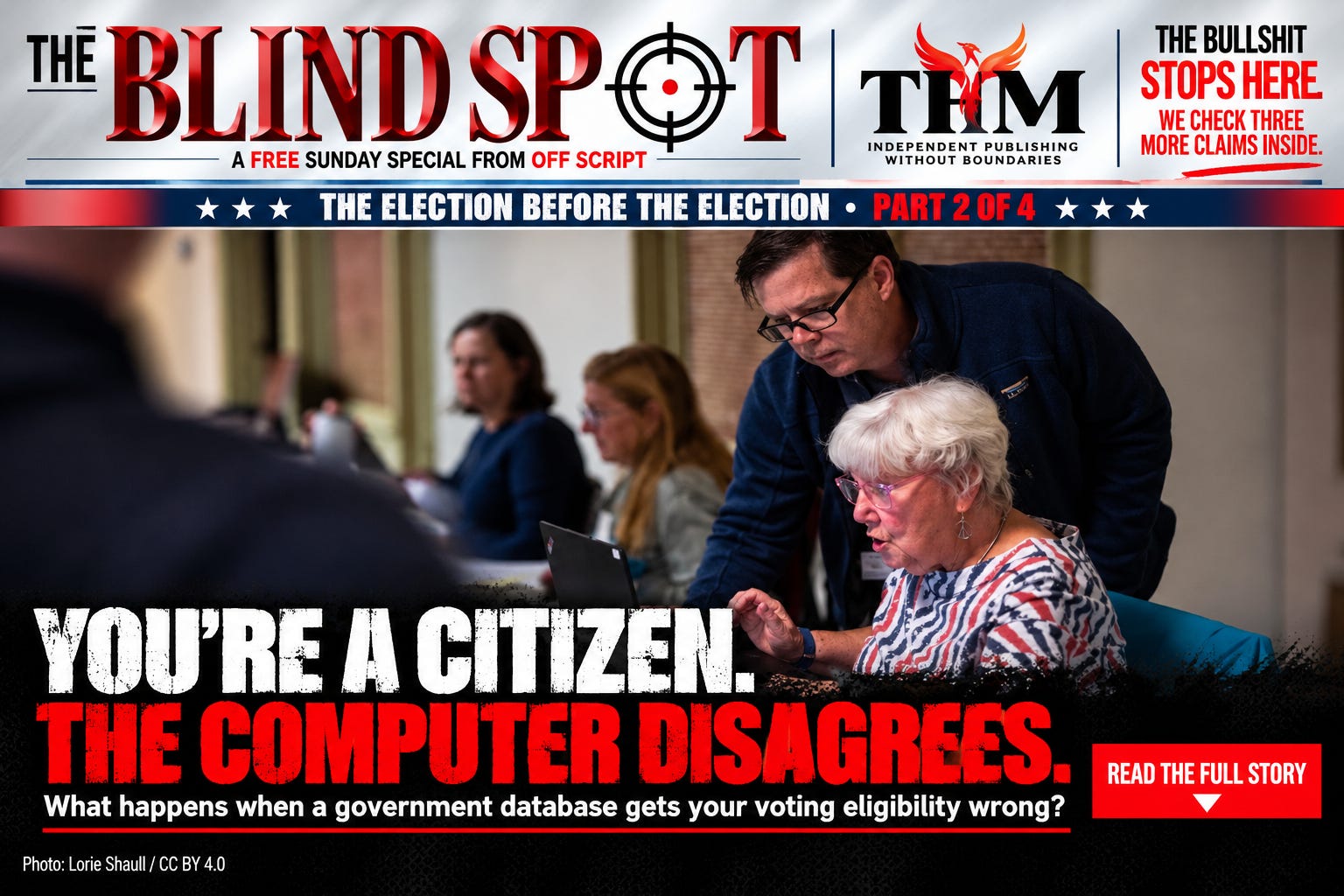
I’ve voted in enough elections to have developed a certain amount of faith in the routine. You go to the polling place, give somebody your name, follow whatever identification procedures your state requires, and cast your ballot. Depending on the election, you might spend more time deciding whether to stop for coffee afterward than you spent actually voting.
That’s the way it’s supposed to work. But there’s something about that routine most of us probably never think about. Before you can cast a ballot, somebody has to decide that you’re entitled to one. Your name has to be on a list, the information has to be correct, and the government has to recognize you as an eligible voter.
We take all of that for granted because, for most of us, it works.
Now imagine arriving at the polls on November 3 and discovering that the government has decided you aren’t eligible. You’re an American citizen. You’ve voted before. You’ve done everything you’re supposed to do. But somewhere along the way, a computer system identified you as somebody who shouldn’t be voting.
What the hell are you supposed to do about that?
It’s not an entirely hypothetical question. And thanks to a federal court ruling issued Friday, October 9, we have another reason to be asking it.
THE RULING, AND WHY IT MATTERS
U.S. District Judge Sparkle Sooknanan ruled against a Trump administration policy under which the Justice Department sought extensive voter registration records from states, compared information with federal citizenship records, and pursued the removal of people identified as potentially ineligible.
The administration said it was trying to prevent noncitizens from voting. That’s already illegal in federal elections, and enforcing that prohibition is a legitimate responsibility. The question before the court wasn’t whether noncitizens should be allowed to vote. It was whether the federal government had the authority to collect and use state voter information in the way it proposed.
Sooknanan concluded that the Justice Department had exceeded its statutory authority. She also found violations of the Administrative Procedure Act, the Privacy Act, and the Paperwork Reduction Act, and vacated the department’s Voter List Maintenance Policy. Read the October 9 opinion in Common Cause v. U.S. Department of Justice, pages 1–3 and 76–78.
You may remember another ruling involving the same judge and the same database back in June. That one concerned the administration’s expansion of SAVE, the federal immigration and citizenship verification system. Sooknanan found that the changes violated federal law and created serious privacy and voting-rights problems.
On September 25, the Supreme Court temporarily stayed that June order while the litigation continued. The October 9 decision involves a separate Justice Department policy, and the judge expressly noted that the Supreme Court’s stay did not determine the outcome of the newer case. October 9 opinion, pages 10–11.
I realize this sounds like a lot of legal machinery to get through before we reach the interesting part, but the distinction matters. The judge didn’t prohibit states from maintaining accurate voter rolls, and she certainly didn’t declare that noncitizens should be allowed to vote. She found that the federal government had adopted a policy it lacked the legal authority to implement.
And there’s a reason we should care about that distinction, regardless of which party controls the Justice Department.
WHAT HAPPENS WHEN THE COMPUTER GETS IT WRONG?
SAVE stands for Systematic Alien Verification for Entitlements. It was developed to help government agencies verify immigration status for certain purposes, but its expanded use in elections has made it central to the current dispute.
In theory, comparing government records sounds sensible. If one database says somebody is registered to vote and another says that person isn’t a citizen, it’s worth investigating. I don’t think anybody seriously objects to checking the accuracy of a voter registration record.
The trouble begins when we start treating a database match as proof.
People become citizens. Government records don’t always update at the same time. Someone may change a name after getting married, or an agency may still have information from years before a person acquired citizenship. Anyone who’s spent an afternoon trying to correct a government record knows that computers are remarkably efficient at preserving mistakes.
And we’re not talking about a remote possibility.
In its October opinion, the court cited a 2006 Social Security Administration audit finding that approximately 3.3 million American citizens had been incorrectly classified as noncitizens in agency records.
That doesn’t mean 3.3 million voters were removed from registration lists. It means the government had documented an enormous number of citizenship-record errors. When those records become part of a system for determining voting eligibility, that history matters.
There’s also more recent evidence.
In Travis County, Texas, an independent investigation found that 25% of the supposed noncitizen matches examined involved people who had already established their American citizenship. That’s not a theoretical computer problem. That’s a verification system producing results that could put eligible voters under suspicion. October 9 opinion, pages 34–36.
Then there’s Anthony Nel.
Nel acquired American citizenship as a child when his parents naturalized. He had a U.S. passport and had been voting in Texas, but the modified SAVE system failed to verify his citizenship. His registration was canceled after he failed to respond to a notice within the required period.
Think about that for a moment. Here’s somebody who is an American citizen, has a passport proving it, and has participated in elections. But the system still managed to treat him as somebody who didn’t belong on the voter rolls. NPR, December 10, 2025 | October 9 opinion, pages 33–36
The court also identified another Texas voter, a naturalized citizen referred to as Bailey Doe, whose registration had been canceled following an erroneous citizenship determination.
So we’ve moved beyond the question of whether a mistake like this could happen. It has happened.
And the government doesn’t get to shrug its shoulders and say the computer made a mistake. The government chose to rely on that computer.
You can subscribe for free and keep reading Off Script and Blind Spot, or become a paid subscriber to help support the research and tools that go into every edition. Either way, I’m glad you’re here.
HOW BIG IS THE PROBLEM WE’RE TRYING TO SOLVE?
There’s something that bothers me about the way noncitizen voting gets discussed.
Listen to certain political speeches and you’d think there are armies of people who aren’t American citizens lining up to cast ballots. And if you question the size of the problem, somebody immediately assumes you must be in favor of letting them vote.
That’s bullshit.
I don’t want anybody voting who isn’t legally entitled to vote. But I also want to know how often it happens before we start building a massive verification system that can make mistakes affecting people who are entitled to vote.
Fortunately, people have tried to answer that question.
After the 2016 election, the Brennan Center for Justice interviewed 44 election administrators representing 42 jurisdictions across 12 states. Those jurisdictions included areas with substantial noncitizen populations and places where allegations of illegal voting had been prominent.
Together, they counted approximately 23.5 million votes. Election officials reported about 30 suspected instances of noncitizen voting that had been referred for further investigation or prosecution. Forty of the 42 jurisdictions reported no known incidents at all.
That works out to approximately 0.00013 percent of the votes counted in those jurisdictions. And remember, suspected doesn’t mean proven. Brennan Center, Noncitizen Voting: The Missing Millions
North Carolina conducted a different kind of investigation following the same election. Rather than interviewing local officials about suspected incidents, state investigators audited election records. They identified 41 noncitizens who had cast ballots, among 508 ballots determined to have been cast by ineligible voters, out of roughly 4.8 million ballots statewide. The Associated Press reported that the audit found no election outcome had changed. Associated Press via WRAL
Now, you might look at those numbers and wonder why North Carolina found 41 cases when the Brennan Center found only 30 across a much larger number of votes. The answer is that these weren’t two measurements of the same population using the same method. One was a survey of selected local officials; the other was a state-level records audit.
Neither investigation can tell us how many illegal votes might have gone undetected nationwide. But both found relatively small numbers of documented or suspected cases in the populations they examined.
And there’s newer evidence that deserves a serious examination.
THE CENSUS REPORT: LET’S DEAL WITH THE ACTUAL NUMBERS
On August 18, the Census Bureau published a preliminary analysis of voting records from the 2020 election. It reported classifying more than 128 million voter records as belonging to citizens and more than 24,000 as belonging to people who were noncitizens at the time of the election. More than 32 million records remained unanalyzed. U.S. Census Bureau, August 18, 2026
Twenty-four thousand is a substantially larger number than those earlier investigations identified. Dismissing it simply because it complicates an argument would be irresponsible.
So let’s put it in perspective.
Compared with the roughly 128 million records classified as citizens, those 24,000 classifications amount to approximately 0.019 percent. That’s a useful measure of scale, but it isn’t a national rate of proven illegal voting. The figures are rounded, more than 32 million records remained unanalyzed, and a database classification isn’t the same as an individually established violation of election law.
The Census Bureau used a commercially obtained voter file along with federal administrative records to make its classifications. It also attempted to account for naturalized citizens, excluding approximately 63,800 people whose records established that they had become citizens before the election.
That was an important safeguard, and it’s only fair to acknowledge it. The researchers didn’t simply assume that everyone with an old immigration record remained a noncitizen forever. Census Bureau, full report, Appendix 2, page 6
But the methodology still depends on accurately matching records and having sufficiently complete citizenship information. Election expert David Becker and other researchers have questioned whether those conditions were consistently met. Lead Stories also examined why the preliminary findings shouldn’t be presented as 24,000 individually proven illegal votes. NPR via KUOW, August 19 | Lead Stories, August 2026
If those records identify genuine cases of illegal voting, election officials should establish what happened and take appropriate action. If some are the result of inaccurate matching or incomplete citizenship information, we need to know that as well.
What we shouldn’t do is declare the case closed simply because the preliminary findings support whichever political position we already held.
And there’s a related question I think we ought to ask every time somebody announces a new system for catching ineligible voters: how many eligible voters does that system incorrectly flag?
Because if we’re measuring success by the number of names identified for removal, without also measuring the mistakes, we’re leaving out a pretty important part of the story.
CONGRESS ANTICIPATED SOME OF THESE PROBLEMS DECADES AGO
The National Voter Registration Act of 1993 established standards for maintaining registration lists while protecting eligible citizens from improper removal. The law includes procedures for handling address changes and other registration issues, and it generally prohibits removing someone simply because they haven’t voted recently. U.S. Department of Justice, National Voter Registration Act
One particularly important protection is the 90-day rule. With exceptions, states must complete certain systematic programs for removing ineligible voters at least 90 days before a federal election.
For the November 3 election, that deadline fell on August 5.
That doesn’t mean election officials stop correcting every problem after August 5. It means certain large-scale removal programs are restricted because the closer you get to Election Day, the harder it becomes for someone to discover and correct a mistake. Justice Department, voter-list maintenance guidance
There’s a practical reason for that. Discover a registration problem in April and you’ve got time to call the election office, collect whatever documents are needed, and straighten things out. Discover it on November 3 and you’ve got a very different situation.
The election isn’t going to be postponed while somebody figures out why the computer thinks you’re somebody else.
Identification requirements can complicate matters further, particularly when people confuse proof of identity with proof of citizenship or registration status. A driver’s license may establish who you are without establishing your citizenship. An older immigration record may accurately describe your status years ago without reflecting the fact that you’ve since become an American citizen.
And even perfectly valid identification won’t necessarily resolve a problem if your name has disappeared from the registration list.
That’s why the practical details matter. How does someone challenge an error? What documentation is required? Is there enough time to correct the record? And if the problem isn’t discovered until Election Day, what happens then?
The answers vary by state. The U.S. Election Assistance Commission provides state-specific information, and Vote.gov directs people to official registration resources.
I know this is where a political column starts sounding like advice from somebody’s father. Mine probably would have worked in a reminder to check the oil while he was at it.
But I’m going to say it anyway.
Check your registration. Now.
Make sure it’s active and that your name and address are correct. Find out what identification your state requires, whether you can vote early, and where you’re supposed to go on Election Day.
If something looks wrong, contact your election office rather than assuming it’ll sort itself out. And if you encounter a problem at the polls, ask what remedies your state provides, including whether you’re eligible to cast a provisional ballot and what follow-up steps may be required to have it counted.
None of this is particularly glamorous. But protecting your right to vote is a damn sight more important than winning an argument on social media.
THERE’S STILL ONE QUESTION I CAN’T SHAKE
I understand the argument for keeping voter rolls accurate. I agree with it. An election can’t function properly if officials don’t know who’s eligible to participate.
But we also have documented examples of American citizens being incorrectly identified as noncitizens, and we have a federal court finding that the Justice Department’s approach exceeded its authority.
There’s something else in that opinion worth considering.
The plaintiffs alleged that the Justice Department was attempting to take over a function traditionally performed by the states and create a nationwide system for identifying and removing voters. The court’s record documented agreements under which cooperating states would remove voters identified by the department within 45 days.
Those are the plaintiffs’ allegations and the documented terms of the agreements, not a judicial finding that every official involved was motivated by a desire to suppress votes. October 9 opinion, pages 1–3 and 35–37
But they certainly provide a legitimate reason to ask questions about what the government was trying to accomplish and why it chose this particular approach.
I don’t pretend to know what every official privately intends. Motive is difficult to prove, and I have no intention of treating suspicion as evidence. But neither do I believe we’re obligated to stop asking questions about motive simply because somebody has attached the words election integrity to a policy.
In a few weeks, we’ll be watching the election returns, listening to people explain why their side won or lost, and hearing enough speculation to last us until the next election. Somewhere beneath all that noise will be millions of individual Americans who simply wanted to cast a ballot and have it counted.
Before we spend another month arguing about who’s going to win, perhaps we ought to make damn sure everybody who’s entitled to participate actually gets the chance.
Because an honest election requires more than preventing people who aren’t eligible from voting. It also requires making sure we don’t prevent people who are eligible from voting.
And when a proposed solution risks doing exactly that, I think we’re entitled to ask two questions.
Does it actually solve the problem?
And is solving that problem the only reason somebody wants it?
If this was worth your time, hit Like, Restack or share it. That’s how independent work like this finds new readers.
THE BULLSHIT DETECTOR
THREE CLAIMS. THREE FACT CHECKS. NO FREE PASSES.
1. BRITAIN IS SECRETLY PREPARING TO DRAFT CIVILIANS INTO A WAR.
💩💩💩💩💩
Claim: Prime Minister Andy Burnham is creating an emergency register of civilians deemed fit to fight.
Bullshit: Full Fact found no evidence of such a government program. Britain’s Ministry of Defence said no such policy exists. The claim appears to confuse the government’s position with a Liberal Democrat proposal for a voluntary civilian reserve to help maintain essential services during emergencies.
Why: If you can’t tell the difference between a volunteer helping keep the lights on and a conscript being shipped off to war, you probably shouldn’t be explaining national defense policy to the rest of us. Full Fact, October 9, 2026
2. GERMANY’S CHANCELLOR IS POCKETING A QUARTER OF THE AID SENT TO UKRAINE.
💩💩💩💩💩
Claim: A video presented as a Bellingcat investigation alleges that Chancellor Friedrich Merz personally receives 25% of Germany’s financial assistance to Ukraine.
Bullshit: Bellingcat told Lead Stories directly that it hadn’t produced the alleged investigation and described the video as part of a long-running Russian disinformation operation. Lead Stories found no credible evidence supporting the underlying corruption accusation.
Why: Fabricating a corruption story is bad enough. Slapping somebody else’s investigative credentials on it is an attempt to make the lie look as though somebody actually did the homework. Lead Stories, October 8, 2026
3. A VIDEO CAPTURES THE MOMENT A MISSILE DESTROYS A PASSENGER JET IN RIYADH.
💩💩💩💩💩
Claim: A viral video shows a Houthi missile striking a Saudia aircraft at King Khalid International Airport on October 8.
Bullshit: The attack happened, and an aircraft was destroyed. But the viral video supposedly showing the moment of impact is fabricated. Lead Stories compared it with genuine aftermath photographs, identified inconsistencies in the airport scene, and found visual glitches in the supposed explosion footage. The investigation also identified similarities to an airport photograph from 2016.
Why: This is an especially ugly kind of deception because the underlying event was real. Somebody apparently decided that actual destruction wasn’t dramatic enough and manufactured a front-row seat to it. Lead Stories, October 9, 2026
ELSEWHERE AT THM
There’s plenty more to explore across Tom Hicks Media.
Chart Collision digs into the music, memories, and stories behind the songs. Lotus Purrspective offers daily observations from a cat who has yet to find a compelling reason to respect humanity. Panic Room Sports looks past the noise to find out what actually happened.
For a trip down memory lane, there’s Rabbit Ears Classic TV and The Backlot Ghost, exploring the television shows and movies we remember, including a few things we probably missed the first time around.
And after all this election business, perhaps we could use a little palate cleanser.
What the Hell? is our newest publication, devoted to true stories so ridiculous you’d swear somebody made them up. Last Sunday, we explained why Idaho once dropped 76 beavers out of airplanes. This Sunday, we’re heading to Louisiana to investigate how an entire lake managed to disappear into the ground. Both stories involve people making decisions that seemed like perfectly good ideas at the time. You can probably guess how that worked out.
Sometimes the truth doesn’t just sound stranger than fiction. It sounds like somebody ought to be fired.
BUY ME A CUP OF TEA
Independent reporting takes time, research, and a few tools that unfortunately don’t accept good intentions as payment. If you’d like to help keep it going, you can buy me a cup of tea. No obligation. Reading, sharing, and joining the conversation help, too.
ONE LAST THING
You don’t have to agree with every conclusion I reach. I’d much rather you question the evidence, check the sources, and tell me where you think I’ve gone wrong.
That’s how we all get a little smarter. - Tom
ONE QUESTION BEFORE YOU GO
If an eligible citizen is wrongly removed from the voter rolls because of a government database error, who should carry the burden of fixing it?
The citizen, or the government that made the mistake?
And what should happen if the error isn’t corrected before Election Day?
I’d like to hear your answer.
#BlindSpot #OffScript #Election2026 #VotingRights #ElectionIntegrity #VoterRegistration #Midterms2026 #THM