
Sunday night, millions of Americans tuned into UFC Freedom 250. Some came for the fights. Some came for the spectacle. Some showed up because a UFC event on the White House lawn sounds like the kind of idea somebody comes up with after three bourbons and a complete breakdown in adult supervision.
Whatever the reason, people were watching the cage.
I was too, right up until I made the mistake of looking around.
That’s usually where the bullshit starts.
The fights were fine. The crowd was loud. The cameras bounced from celebrities to politicians to wealthy people who somehow always seem to appear whenever enough power and television cameras occupy the same patch of ground. The coverage followed the usual script — show the fighters, show Trump, show the celebrities, show the crowd, repeat until somebody gets punched in the face.
Fair enough. That’s what people came to see.
Then I started paying attention to who was actually standing around the White House lawn, and suddenly the whole thing became a hell of a lot more interesting.
Mark Zuckerberg was there, which isn’t exactly shocking. At this point Zuckerberg seems to travel by teleporting directly to any location where power, influence, and cameras intersect. Dana White was there too, because if you’re hosting a UFC event on government property it helps if the guy running the company actually shows up. There were politicians, executives, celebrities, wealthy donors, and enough combined net worth to make a small nation’s finance minister question his career choices.
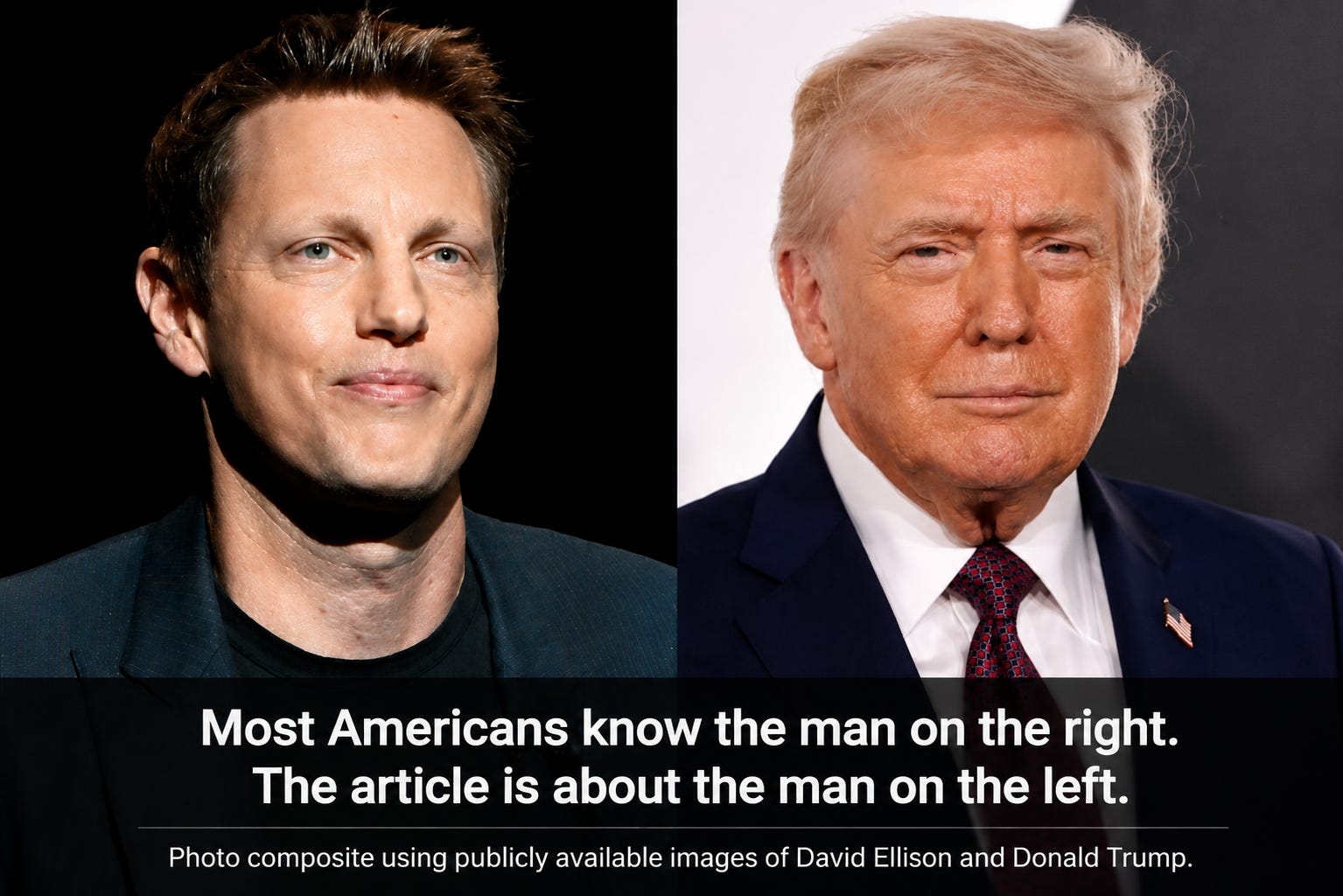
Then I spotted David Ellison.
Most Americans have never heard of David Ellison.
That’s exactly why he’s worth paying attention to.
While the cameras focused on the spectacle, Ellison had just received regulatory approval for a deal that, according to multiple media reports, would place CBS, CNN, HBO, Warner Bros., and a growing collection of media properties under the same corporate roof. Millions of Americans know those brands. Millions consume their content every day. Very few could tell you who is increasingly ending up in charge of them.
That’s when I put my metaphorical beer down. Not because I suddenly developed a passion for corporate mergers. And not because reading regulatory filings sounds like a fun way to spend a Sunday evening. I paid attention because ownership matters.
The people who own things make decisions. They decide what gets funded, what gets canceled, who gets promoted, who gets sidelined, and who gets called into a conference room to hear a human resources representative explain that the company is “moving in a different direction” — which is corporate America’s thousand-dollar way of saying, “Pack your shit.”
Join Us Every Morning
For the last twenty years, Americans have been trapped in an endless argument about media bias. Conservatives scream about CNN. Liberals scream about Fox News. Everybody screams about social media, social media blames the algorithm, and the algorithm probably blames Mercury being in retrograde.
Round and round we go.
Meanwhile, a handful of rich bastards have been quietly buying bigger and bigger pieces of the media ecosystem while the rest of us argue about the programming. We’ve spent two decades fighting over the television remote while somebody was purchasing the goddamn television station.
That’s the story. Not whether one network leans left. Not whether another leans right. Not whether some talking head said something stupid on a Tuesday afternoon.
The story is ownership.
Because owners don’t have to dictate every headline to shape what the public hears. They don’t need to stand over reporters with a stopwatch and a script. They simply decide who gets the microphone, who gets the spotlight, and who gets shown the exit.
If MSNBC somehow owned every microphone in America, conservatives would be right to worry. If Fox News somehow owned every microphone in America, liberals would be right to worry. The principle doesn’t change just because your team happens to be winning this week’s political argument. Concentration of power deserves scrutiny regardless of whose hands it’s falling into.
That’s why the guest list mattered. Not because rich people attended a UFC event. Rich people attend things all the damn time. If somebody opened a luxury yacht dealership tomorrow and offered free shrimp cocktail, half the people on that lawn would probably be standing in line for the ribbon-cutting.
The interesting part wasn’t that powerful people gathered in one place. The interesting part was which powerful people gathered in one place.
Earlier this year, Ellison hosted a Washington dinner attended by senior administration officials, including people connected to the administration overseeing federal approval of his growing media empire. A few months later regulators approved a merger that dramatically expands his reach. Then, just days after that approval, there he was at one of the most visible events in the country, standing among people who collectively influence enormous portions of American politics, technology, media, finance, and culture.
Maybe that’s all perfectly innocent.
Then again, if a Democratic administration approved a massive media merger after the buyer spent months socializing with senior White House officials, half the country would be foaming at the mouth and demanding hearings before breakfast.
Power deserves scrutiny. The more power somebody accumulates, the more scrutiny they deserve. That shouldn’t be controversial. It should be common fucking sense.
Keep the receipts hot and the bullshit detector fully operational.
The reason this story stuck with me isn’t because of one merger, one dinner, or one UFC event.
It’s because all of them point toward the same larger question.
Who actually holds power in modern America?
Most of us can name the politicians. We can name the celebrities. We can name the people standing in front of the cameras.
The harder question is who’s standing behind them.
One of the strangest things about modern America is that we have more information than any society in human history. There are thousands of websites, hundreds of television channels, millions of social media accounts, podcasts covering every topic imaginable, and enough content uploaded every minute to keep a person busy until the sun burns out. Yet ownership keeps moving in the opposite direction. Every year there are more places to consume information and fewer people controlling larger pieces of it.
That’s not a conspiracy theory. That’s a business trend. And when business trends get big enough, they become political trends whether anybody likes it or not.
The reason Freedom 250 stuck with me has nothing to do with who won the fights. By next week most people won’t remember the undercard, and a month from now they’ll barely remember who walked into the arena first. What won’t disappear is the larger trend sitting underneath all of it.
Political power. Media power. Financial power. Tech power.
Those forces aren’t identical, but they increasingly travel in the same circles, attend the same events, know the same people, and occupy the same rooms. Every once in a while you get a glimpse of that reality all in one place.
Sunday night was one of those glimpses.
David Ellison wasn’t the most famous person there. He wasn’t the loudest person there. He wasn’t the person drawing the biggest cheers.
He may very well have been the most powerful.
And that’s the part worth thinking about.
Americans spend an extraordinary amount of time arguing with the people holding the microphones and almost no time paying attention to who’s buying the sound system.
That’s the real story. Not the birthday. Not the spectacle. Not the fight.
The ownership.
Because long after the crowd goes home, the cameras shut off, and the country finds a new shiny object to obsess over, we’ll still be living with the consequences of a question that gets more important every year:
Who the hell owns the microphones?
One Question Before You Go
If ownership matters, why do we spend so much time arguing about the people holding the microphones and so little time paying attention to who’s buying them?
The daily Bastard is free.
War Room subscribers get the deeper investigations, expanded analysis, and the stories that don’t fit inside a single morning article.
Bastardonia Fact: Bastardonian antitrust law states that if one guy owns all the microphones, somebody’s getting audited.
#TheUnredactedBastard #MediaOwnership #CorporatePower #Politics #DavidEllison #MediaConsolidation #Democracy #Freedom250