
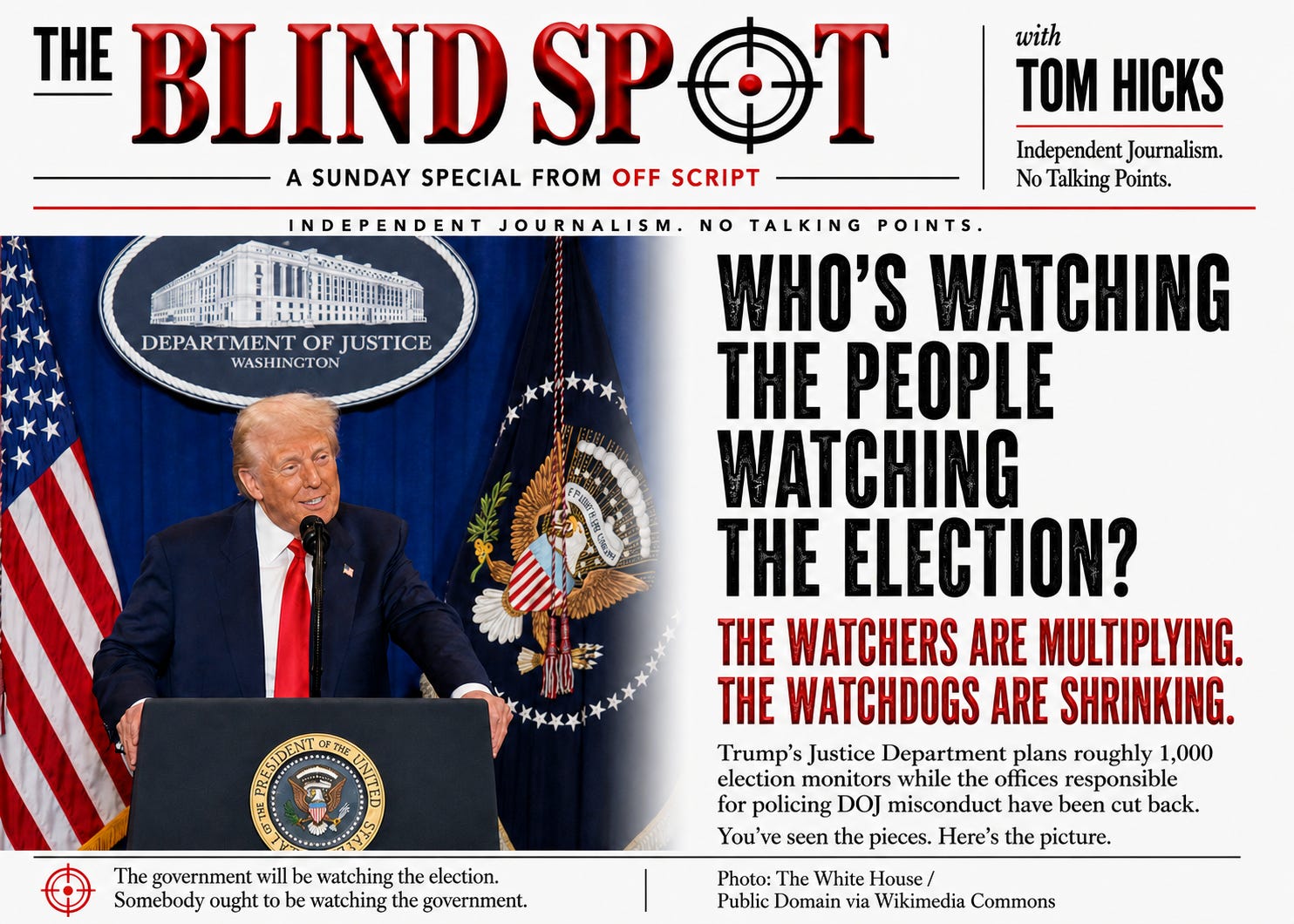
THE BLIND SPOT | A SUNDAY FEATURE FROM OFF SCRIPT
By Tom Hicks | August 30, 2026
EDITORIAL NOTE
There’s no secret document behind this story. I don’t have a whistleblower whispering about some hidden master plan, and I’m not going to pretend I do. Almost everything you’re about to read has already appeared somewhere in the news. The Blind Spot is what happens when we stop treating those stories as unrelated and put the damn pieces on the same table.
That distinction matters because there’s a hell of a difference between evidence and prediction. I can show you what the Trump administration has done, what it says it intends to do, and what machinery it has put into place ahead of November 3. I can also show you what Donald Trump himself has said about controlling elections and what happened the last time he didn’t like an election result. From there, you’re perfectly capable of looking at the picture yourself.
Wyoming Wasn’t Supposed To Be The Problem
If I told you state officials were complaining about aggressive Trump Justice Department election monitors showing up at polling places, you might guess California. Maybe New York. You probably wouldn’t start with Wyoming, where Donald Trump won by almost 46 points in 2024, and Republicans control damn near everything worth controlling. That’s exactly why Wyoming is such a good place to begin.
Republican Gov. Mark Gordon ordered his attorney general to investigate after two DOJ monitors appeared during the August 18 primary in Laramie County. Gordon described their conduct as “aggressive” and “irregular,” while County Clerk Debra Lee said they sought voter interviews, information about poll-worker training and access to voting equipment. Lee refused some of those requests, and nobody has alleged that the monitors altered a vote or affected the result.
Gordon’s reaction was about as Wyoming as you’d expect. He said he doesn’t like Washington coming for the state’s guns, and he doesn’t like Washington coming for its votes either. When the Republican governor of one of the reddest states in America starts wondering what Donald Trump’s Justice Department is doing around his voting machines, I’m inclined to put down my drink and listen.
First, The Part That’s Completely Normal
The Justice Department has monitored elections for decades, and that by itself is no scandal. The Civil Rights Division sends attorneys, staff and, where legally authorized, federal observers to watch for violations of federal voting-rights laws. It’s legitimate work that has helped protect voters from discrimination, intimidation and barriers to casting a ballot.
The Biden Justice Department monitored 64 jurisdictions in 24 states during the 2022 general election and 86 jurisdictions in 27 states in 2024. Those are jurisdiction counts rather than individual personnel, so comparing them directly with this year’s planned 1,000 monitors would be bullshit in its own right. The important point is that federal monitoring didn’t suddenly begin when Trump returned to office.
That’s worth establishing before we go any further. The question isn’t whether federal election monitoring is inherently sinister, because it isn’t. The question is what this Justice Department is monitoring, how far its people believe their authority extends, and what else is happening around the election at the same time.
Now Let’s Talk About The 1,000
Assistant Attorney General Harmeet Dhillon, who runs DOJ’s Civil Rights Division, says the department plans to deploy roughly 1,000 federal monitors for the November midterms. CBS News reported that Dhillon described it as a record deployment, while DOJ says the mission is neutral enforcement of federal election law rather than taking control of local election administration. That assurance matters and belongs in this story.
DOJ has already sent more than 80 monitors across seven states and more than 200 polling locations during this year’s primary season. Its own announcements describe the work as promoting transparency, ballot security, and communication with local election officials. Then Wyoming gave us an example of what can happen when federal officials and local officials have very different ideas about where monitoring ends.
Wyoming doesn’t prove November will be abusive. It proves that questions about the boundaries aren’t theoretical anymore. If you’re about to put roughly a thousand federal monitors into an already combustible election, the dress rehearsal is worth watching.
KEEP READING THE BLIND SPOT
So far we’ve got a legitimate federal function, a dramatically expanded deployment, and one Republican state already asking questions about how that function was exercised. None of that proves some grand plan to interfere with the election. The picture changes when we start adding the other pieces.
UPGRADE TO PAID TO CONTINUE READING
🔒 PAID SUBSCRIBER CONTENT BELOW
The Voter Rolls
The Justice Department has spent months demanding statewide voter-registration lists and suing governments that won’t hand them over. By April 1, DOJ said it had sued 30 states and the District of Columbia, and the list includes Republican states such as Idaho, Kentucky, Oklahoma, Utah and West Virginia. This is much broader than Trump simply picking fights with Democratic governors.
DOJ says federal election laws give the attorney general authority to obtain and analyze those voter files. In May, the department’s Office of Legal Counsel went further, concluding that federal law permits DOJ to share statewide registration data with Homeland Security so it can be cross-checked against other government databases for voter-fraud investigations. That’s the administration’s legal position, and courts may ultimately decide where its limits are.
At the same time, the administration has vastly expanded the use of Homeland Security’s SAVE system to check voter eligibility. By May, more than 67 million registrations had been run through the system, while voting-rights groups warned that database mismatches can flag legitimate citizens along with genuinely questionable records. The administration says the effort protects election integrity, while critics say an imperfect immigration database is a dangerous tool for determining who gets to vote.
Nobody has to invent a nationwide purge to find that consequential. The federal government now has more voter information, more tools for cross-checking it and more involvement in decisions that can eventually determine whether somebody remains registered. Keep that piece on the table.
Then There’s Your Mailbox
Trump has attacked mail voting for years despite using it himself, and this year the fight moved from rhetoric into federal policy. His executive order sought to create new requirements involving voter lists, mail ballots and the Postal Service, prompting lawsuits from states and voting-rights organizations that argue the president is invading authority belonging to states and Congress. The administration says it’s closing election-security gaps.
The Supreme Court recently lifted one legal obstacle on procedural grounds, but it didn’t rule that Trump’s plan is constitutional. Once the Postal Service finalized the rules needed to carry it out, another round of litigation began almost immediately. That distinction matters because “Supreme Court lets Trump do it” is much simpler than what actually happened.
On August 28, federal Judge Indira Talwani temporarily blocked the newest version, saying states didn’t have enough time to overhaul their systems before mail voting begins. The Trump administration appealed the next day, and nearly one-third of voters used mail ballots in 2024. We are now litigating major rules governing those ballots with the election barely two months away.
So put another piece on the table. The administration is fighting for voter data while simultaneously fighting to change how millions of mail ballots move through the system. Whatever courts ultimately allow, nobody can credibly describe this White House as taking a hands-off approach to the mechanics of the 2026 election.
A Lot Of The Old Guardrails Are Gone
ProPublica did something very similar to what we’re doing here, except with the federal personnel who helped keep the 2020 election from being overturned. Its investigation found at least 75 career officials involved with election integrity or security are gone, having resigned, been fired or been reassigned. Roughly two dozen Trump appointees have moved into positions capable of affecting elections, and ten were involved in efforts to reverse the 2020 result.
Nearly all of the roughly 30 career lawyers who once worked in the Civil Rights Division’s voting section have also resigned or been moved, according to ProPublica. The Trump administration says these changes redirected agencies toward their proper missions and away from activities it considered political or outside their statutory authority. That defense belongs here too, because personnel changes alone don’t prove wrongdoing.
They do change the institutional environment. In 2020, Trump appointees, including Attorney General Bill Barr, eventually told him things he didn’t want to hear and refused to help overturn his loss. A lot of the people who formed that kind of resistance aren’t sitting in those chairs anymore.
Who Watches The Justice Department?
This may be the piece that bothers me most.
Reuters reported this month that DOJ’s Office of Professional Responsibility, which investigates misconduct by department lawyers, has dropped from 29 employees to 16 during Trump’s second term. OPR opened only seven new investigations in fiscal 2025, its lowest number in roughly two decades, while receiving a record 1,666 complaints. DOJ says the office remains capable of performing its duties.
The Justice Department Inspector General’s office has lost another 99 employees. Former officials told Reuters that politically sensitive investigations have become more difficult, while DOJ maintains that misconduct allegations continue to receive appropriate scrutiny. None of this means election monitors have suddenly been freed from every legal and ethical restraint.
But here’s the equation I can’t get past. DOJ is dramatically increasing the number of federal personnel watching an election while some of the internal machinery responsible for investigating DOJ misconduct is getting smaller and less active. The people watching the election are multiplying while some of the people watching the watchers are disappearing.
That should bother you whether your preferred political hat is red, blue or made entirely out of cheese.
“The Republicans Ought To Nationalize The Voting”
This whole thing would be considerably easier to shrug off if Donald Trump had spent the year emphasizing the traditional state role in running elections. He hasn’t. In February, he publicly said Republicans should “take over the voting” and “nationalize the voting,” suggesting action in roughly 15 locations while again making unsupported claims about widespread illegal voting.
The Constitution gives states primary responsibility for the times, places and manner of congressional elections while allowing Congress to make or alter those rules. It doesn’t give the president general authority to take over elections because he thinks a state is crooked. The White House has framed Trump’s comments around national voter-ID and proof-of-citizenship proposals, which is its explanation and deserves to be included.
Here’s where a little selective outrage is completely appropriate. If Barack Obama had gone on a podcast and said Democrats should take over voting in 15 states before a midterm election, Fox News would’ve needed asbestos curtains around the graphics department. We wouldn’t have spent six months patiently discussing whether everybody was misunderstanding him.
Presidents shouldn’t talk like that about elections. Period.
And What About ICE Or The National Guard?
In May, Trump was asked directly whether he would send National Guard troops or ICE officers to voting locations in November. He didn’t rule it out, saying he would do whatever was necessary to ensure “honest elections.” The White House and DHS have said there’s no announced plan to put ICE agents at polling places, and federal law sharply restricts the presence of armed federal personnel around elections.
There’s a world of difference between DOJ lawyers lawfully monitoring compliance with voting-rights statutes and armed immigration officers standing near people waiting to vote. State election officials have been preparing for the possibility precisely because the administration’s public messages haven’t closed the door on it. That doesn’t mean it will happen.
I’d be delighted if that entire concern looks ridiculous by November 4. I’d also be delighted if somebody in the White House would simply make it ridiculous now by saying armed federal agents won’t be showing up at polling places. So far, Trump himself hasn’t done that.
Could Trump Cancel The Midterms?
No.
Federal law sets congressional Election Day as the Tuesday after the first Monday in November of every even-numbered year. The Constitution places congressional election regulation with the states and Congress, not the president. Donald Trump can’t simply sign an executive order on November 2 saying everybody gets the day off and we’ll try democracy again sometime after Christmas.
I want that answer stated plainly because there’s enough real shit happening without inventing powers the president doesn’t possess. There isn’t a general presidential emergency authority that lets him cancel congressional elections because he dislikes the political environment. If somebody tells you Trump can legally call off the midterms by himself, they’re wrong.
The reason we’re dipping a toe into this water at all is that Trump keeps putting the water in front of us. At a January 6 House Republican retreat, he raised the idea of canceling the election while simultaneously saying the press would accuse him of being a dictator if he suggested such a thing. Days later, during a Reuters interview in which he discussed the possibility of Republican midterm losses, he said his administration was doing so well that “we shouldn’t even have an election.”
The White House said he was joking. Maybe he was. I’ve told jokes too, although mine usually aren’t followed by federal lawsuits for voter rolls, attempts to change mail-ballot rules, talk about nationalizing voting, and a thousand Justice Department monitors.
Context has a nasty habit of screwing up the punch line.
Canceling The Election Is The Wrong Question
I don’t think the most plausible threat to the 2026 midterms is Trump walking to a podium and declaring that there won’t be an election. The legal barriers are enormous; states would resist, Congress has statutory authority, and the lawsuits would begin before he finished the sentence. Fixating on that movie version can actually distract us from things that are happening in broad daylight.
A president doesn’t have to cancel Election Day to make an election harder to administer. Eligibility disputes can knock voters into bureaucratic limbo, federal rules can create confusion around mail ballots, litigation can keep changing instructions as voting begins, and federal personnel can create conflicts with state officials about who has authority to do what. None of that requires tanks outside the elementary school gym.
And a president doesn’t have to stop people from voting to attack the legitimacy of what they produce.
We’ve already seen that movie.
What Happens If Republicans Are Losing?
That’s the question I keep coming back to, because Trump himself has made the stakes personal. In January he warned House Republicans that if they lose the midterms, Democrats will find a reason to impeach him. He has also continued to falsely insist that he won the 2020 election, so imagining him calmly accepting every close Democratic victory in November requires us to ignore five years of evidence about how he reacts to losing.
Picture November 3 without inventing anything. Republicans are losing several close House races, thousands of mail ballots remain uncounted, federal monitors are present in contested jurisdictions, and lawsuits are already flying. Maybe everything works exactly as it should.
I hope it does.
But if Trump starts claiming fraud before the count is complete, he would be doing it with a Justice Department far more aligned with him than the one he had in 2020, a massive federal voter-data effort already underway and many of the election-security officials who resisted his first attempt gone. That doesn’t tell us what will happen. It tells us what the playing field looks like if something does.
You’ve Seen Every Piece Of This Before
That may be the most important part of this story.
The thousand DOJ monitors were a story. Wyoming was another story, the voter-roll lawsuits were another, the Postal Service fight was another, the disappearance of election-security officials was another, Trump’s nationalize-the-voting comment was another, and the shrinking DOJ watchdog offices were another. News moves so fast now that each piece gets its twelve-hour turn in the outrage machine before the next one shoves it off the bar stool.
Put them together, and you don’t get proof that Donald Trump has a secret plan to cancel the midterms. You get something more useful: a federal government exerting considerably more pressure on the mechanics of an election while some of the institutional restraints around that power have weakened. That’s an observable fact, and we don’t need to decorate it with a conspiracy theory.
Maybe every safeguard holds. Maybe the courts establish clear boundaries, DOJ’s monitors behave exactly as promised, eligible voters remain registered, mail ballots move normally, and November 3 turns out to be an ordinary American election. I sincerely hope the most embarrassing thing about this article in December is that I worried too much.
I’d happily take that deal.
THE BULLSHIT DETECTOR
TRUMP SAYS NEVADA TIPPED WORKERS SAVED AN AVERAGE $10,000 IN TAXES
BULLSHIT RULING: THE DEDUCTION ISN’T THE SAVINGS.
Trump says 440,000 tipped workers in Nevada saved an average $10,000 on their taxes because of “no tax on tips.” FactCheck.org found no federal data supporting either the worker count or the claimed savings, and Trump appears to be confusing the amount deducted from taxable income with the amount actually saved in taxes. A $10,000 deduction for a worker in a 12% marginal bracket would save roughly $1,200, which is a lovely tax break but considerably less lovely than pretending $1,200 is $10,000.
VANCE SAYS TRUMP “SEALED THE BORDER,” SO MAINE OVERDOSES FELL
BULLSHIT RULING: THE DECLINE STARTED BEFORE TRUMP GOT THERE.
JD Vance credited Trump’s border policies for Maine’s falling overdose deaths, but the decline was already underway during the Biden administration. Maine fatal overdoses fell from 2022 to 2023, again in 2024, and about another 20% in 2025, while researchers point to several factors including changes in fentanyl supply, treatment, and expanded naloxone access. Taking sole credit for a trend that started before you entered the building isn’t causation; it’s walking into the fourth inning and demanding credit for the first three runs.
BYRON DONALDS BLAMES MEASLES OUTBREAKS ON “RAMPANT ILLEGAL IMMIGRATION”
BULLSHIT RULING: THE EVIDENCE POINTS TO FALLING VACCINATION RATES.
Florida Republican gubernatorial nominee Byron Donalds said illegal immigration under Biden caused measles outbreaks around the country. Infectious-disease experts told PolitiFact the primary driver is declining MMR vaccination rates, and no available data ties the outbreaks to immigrants living in the country illegally. About 94% of confirmed 2026 cases have occurred among people who were unvaccinated or whose vaccination status wasn’t known, which seems like a more useful place to look than whichever border talking point happened to be lying around.
NORTH CAROLINA “PROCESSED” MORE THAN A MILLION DUPLICATE VOTER REGISTRATIONS
BULLSHIT RULING: TRUE NUMBER, BULLSHIT IMPLICATION.
More than a million North Carolinians who were already registered submitted another registration application before the 2024 election, so the number circulating online is real. What the viral claim leaves out is that those people weren’t added to the voter rolls a second time, and state officials say the duplicate applications had “absolutely no relationship” to election results. This is exactly how election bullshit works best: start with a real number, remove the explanation, place it next to an election result, and let frightened people invent the crime for you.
WANT YOUR OWN BULLSHIT DETECTOR?
The Bullshit Detector is the Tom Hicks Media guide to spotting manipulation, bad statistics, loaded language, fake certainty, and the tricks people use when they’d rather you react than think. Off Script subscribers can get it free, while everyone else can pick it up for $4.95 in the Tom Hicks Media Store. Election season seems like a pretty good time to keep one handy.
MORE FROM TOM HICKS MEDIA
LOTUS PURRSPECTIVE
Lotus Purrspective is what happens when a tuxedo cat gets daily access to human behavior and absolutely no reason to be impressed by it. Saturdays bring the Species Review, which gives other animals their chance to be judged too.
TOM’S NUMBER ONES
Tom’s Number Ones rebuilds a different week in Billboard history every morning through the records that were actually No. 1. Sundays also bring The Afterlife Charts, tracking what old music is doing in the streaming world right now.
PANIC ROOM SPORTS
Panic Room Sports brings smart football coverage with attitude and considerably less patience for manufactured panic. The free 2026 Fantasy Draft Guide is also available for anyone who’d rather not discover their brilliant draft strategy depended on seventeen strangers cooperating.
RABBIT EARS CLASSIC TV
Rabbit Ears TV goes back inside classic television without pretending everything behind those old shows was warm and fuzzy. New editions arrive Mondays and Thursdays.
THE BACKLOT GHOST
The Backlot Ghost walks through classic movies looking for the stories that stayed behind after the cameras stopped. New editions arrive Wednesdays and Saturdays, usually after dark where they belong.
BUY ME A CUP OF TEA
The Blind Spot takes time because the point isn’t to rewrite whatever story everybody else published yesterday. It’s to read across those stories, check the original material, and figure out whether the pieces say something together that they didn’t say alone. If you’d like to help keep that work going, you can buy me a cup of tea.
ONE QUESTION BEFORE YOU GO
We know a president can’t legally cancel the November midterms on his own. What I’m more interested in is whether everything already happening around the election makes you more concerned about what could happen before, during, or after Election Day. Which piece of this picture bothers you most?
ONE LAST THING
I’m not telling you Donald Trump is going to cancel the midterm elections. I’m telling you that a president who tried to overturn one election loss, still says that election was stolen, has talked about nationalizing voting and now oversees a federal government becoming far more involved in the mechanics of this election. Those facts belong in the same conversation.
Maybe November goes beautifully. I hope it does, because wanting the warning to be right would be a pretty fucked-up definition of winning. The best possible ending to this story is a boring Election Day followed by accurate counts, accepted results and everybody going home.
Until then, watch the pieces.
The government will be watching the election. Somebody ought to be watching the government.
Independent publishing survives because readers decide it should. Your paid subscription supports the research and independent journalism behind The Blind Spot and every Tom Hicks Media publication. Thanks for reading, sharing and helping keep it independent.
#TheBlindSpot #OffScript #TomHicksMedia #Election2026 #VotingRights #DOJ #Midterms2026 #DonaldTrump #IndependentJournalism #BullshitDetector