

Editorial Note
A headline making the rounds this weekend says American wages have fallen to roughly 43% of national income, their lowest share since the Great Depression, and asks whether Richard Nixon caused the whole mess when he severed the dollar’s final link to gold in 1971. There’s a legitimate story underneath that headline, but it gets more interesting once you stop trying to blame one president and one monetary decision for half a century of economic change.
The 43% figure measures wages and salaries, not everything workers receive in compensation. Employer-paid benefits such as health insurance and retirement contributions are excluded, which means Americans have not somehow watched 57% of their paychecks disappear. The article itself acknowledges that distinction, and it matters.
What matters even more is another number that requires considerably less explaining.
Here’s the Number That Should Piss You Off
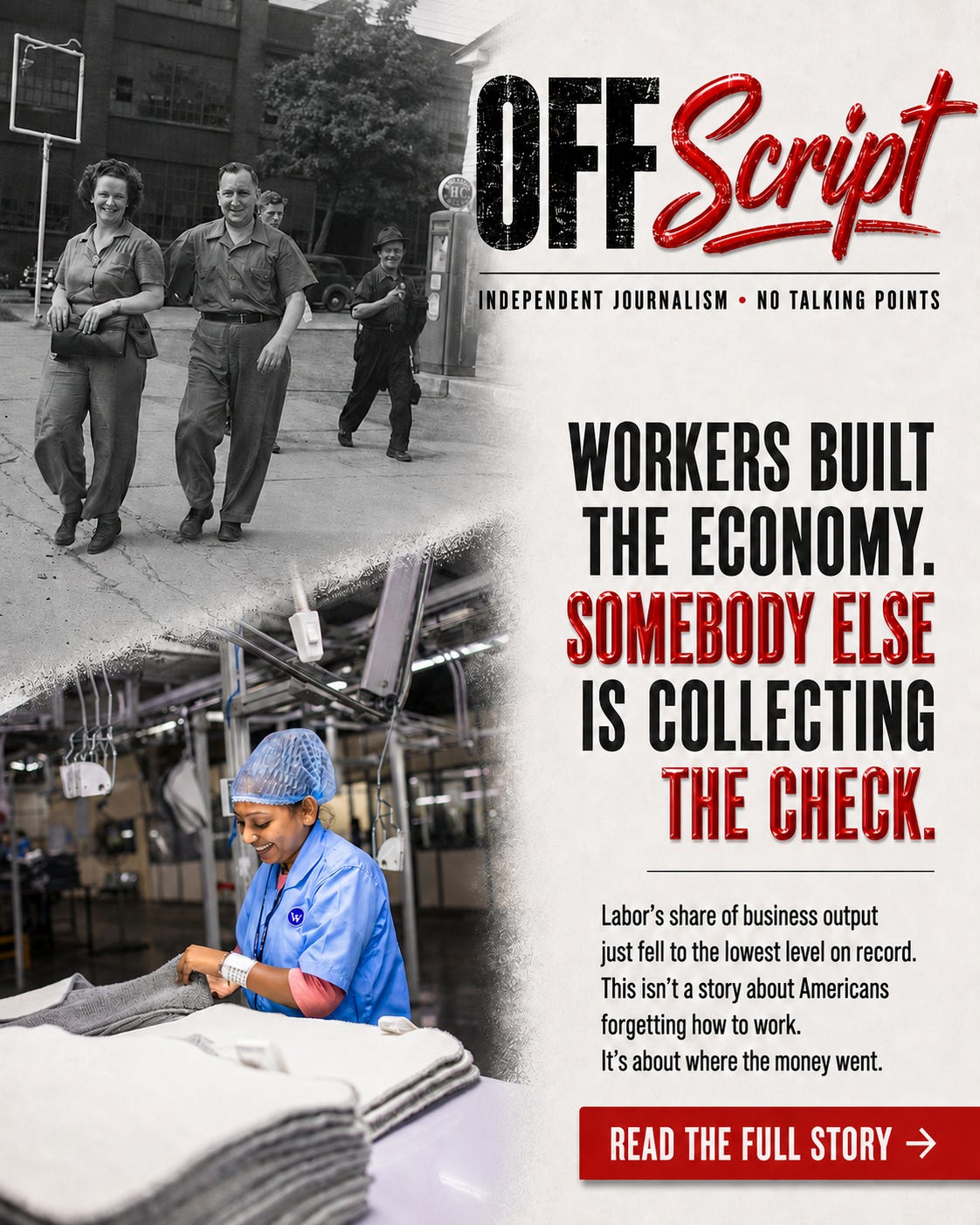
On August 6, the Bureau of Labor Statistics reported that labor’s share of nonfarm business output fell to 52.9% in the second quarter of 2026. BLS defines labor share as the percentage of output that goes to workers in compensation, so this one includes more than somebody’s base wage. It is the lowest reading since the series began in the first quarter of 1947.
In that same quarter, worker productivity increased at a 1.4% annual rate. Output increased 1.7%, while hours worked increased only 0.3%, meaning American workers once again managed to squeeze more production out of the time they spent working. Over the previous year, productivity increased 2.2%.
Now comes the fun part, assuming your definition of fun includes checking whether your blood pressure medication is nearby. Inflation-adjusted hourly compensation fell 3.1% during the quarter at an annual rate and was down 0.1% from a year earlier. Workers became more productive while their share of what they produced fell to a 79-year low.
That isn’t a slogan from Bernie Sanders. It isn’t a meme somebody slapped together on Facebook at 2:30 in the morning. Those numbers came from the United States Bureau of Labor Statistics.
And they raise a fairly obvious question.
Who got the rest?
Support Independent Work
Your subscription helps fund reporting, research, publishing, new features, and the continued growth of every Tom Hicks Media publication.
Funny You Should Ask
Corporate America isn’t exactly rummaging through the couch cushions.
The Bureau of Economic Analysis reported that corporate profits from current production were running at an annualized $4.426 trillion in the first quarter of 2026, up from $4.352 trillion in the previous quarter. For all of 2025, the figure was $4.078 trillion.
There is nothing inherently sinister about a company making a profit. If you open a sandwich shop, sell a lot of sandwiches and make money doing it, congratulations. That’s generally why you opened the damn sandwich shop.
The problem begins when an economy can produce record-low labor shares alongside enormous corporate profits and then spend years telling workers the real problem is that they need to become more productive. They already did. The productivity showed up.
The money just didn’t necessarily show up in the same place.
The Great American Split
For decades after World War II, worker compensation and productivity generally moved together. The Bureau of Labor Statistics has found that from 1947 to 1973, real hourly compensation increased at roughly the same rate as labor productivity. The separation became increasingly pronounced afterward, and since 2000, declining labor share itself has become an important part of that gap.
The Economic Policy Institute, using BLS and BEA data with adjustments designed to compare productivity with compensation for ordinary production and nonsupervisory workers, puts the modern divergence in terms anyone can understand. From the fourth quarter of 1979 through the first quarter of 2026, productivity increased 93.2%. Compensation for those workers increased 33.7%.
That doesn’t mean nobody’s income rose along with productivity. Some people’s income did spectacularly well. EPI finds that a growing share of the gains went toward highly paid corporate and professional employees and toward profits and returns received by shareholders and other owners of capital.
So we’ve spent decades having the wrong argument. Americans keep getting asked whether workers deserve raises as though productivity is something they’re supposed to provide in advance as proof of good behavior.
They provided it.
So Did Nixon Screw Everybody?
On August 15, 1971, Richard Nixon announced that the United States would suspend the dollar’s convertibility into gold. Under Bretton Woods, foreign governments had been able to exchange dollars for U.S. gold at a fixed price, but mounting U.S. deficits, inflation, and more dollars circulating abroad than America could realistically redeem were putting the system under enormous strain. Nixon closed what became known as the gold window, and by 1973 the major currencies had largely moved to floating exchange rates.
If you look at a chart showing productivity and worker compensation separating during the 1970s, it’s tempting to circle 1971 with a red marker and yell, There! Nixon did it!
History is rarely considerate enough to be that simple.
The end of gold convertibility absolutely changed the international monetary system, and the dollar’s purchasing power has declined substantially over the decades since. But the Federal Reserve’s own history shows the Bretton Woods system was already under tremendous pressure from inflation, U.S. deficits and an insufficient gold stock before Nixon acted. The Great Inflation had begun years before the gold window closed and continued well afterward.
More importantly, economists studying the decline in labor’s share haven’t found a smoking gold bar.
BLS reviews of the research point toward a messier combination of forces: automation replacing some labor, offshoring and globalization, changes in the mix of industries, increased use of imported inputs, and capital-intensive businesses capturing larger portions of their markets. Researchers have also looked at declining worker bargaining power, outsourcing, weaker unions, and the rise of highly profitable “superstar” companies that can generate enormous sales with comparatively fewer employees.
That’s frustrating if you want one guy, one date and one button marked THIS IS WHERE EVERYTHING WENT TO HELL.
Economies don’t usually come with one.
There Was Another Big Change
In 1983, the first year for which comparable BLS figures are available, 20.1% of American wage and salary workers belonged to unions. In 2025, it was 10%. In the private sector, union membership has fallen to 5.9%.
Whether you love unions, hate unions, or regard them the way you regard a suspicious noise coming from the basement, bargaining power matters. An individual worker asking a multibillion-dollar corporation for more money does not walk into that conversation holding the same cards as thousands of workers negotiating together. You don’t need a Che Guevara poster over your bed to understand leverage.
BLS research has specifically identified declining union membership, offshoring, outsourcing, and restrictions on worker mobility as possible contributors to reduced worker bargaining power. Automation can strengthen the company’s hand further because the worker isn’t merely bargaining against another human willing to accept less. Sometimes he’s bargaining against a machine that doesn’t require health insurance, vacation days or lunch.
That’s quite a change from an economy in which productivity gains and worker compensation routinely traveled together.
It Wasn’t Inevitable
This is the part I find hardest to swallow.
We’re often told the modern economy simply evolved this way. Technology changed. Manufacturing moved. Global competition arrived. Computers happened, robots showed up, and apparently everybody was supposed to shrug while the paycheck wandered off in another direction.
Except different policies decide who has leverage when those changes occur.
Tax rules decide how different forms of income are treated. Labor law helps determine how easily employees can organize. Antitrust enforcement affects how concentrated corporate power becomes. Trade rules determine the conditions under which companies move production abroad, while minimum-wage policy sets a floor under the bottom of the labor market.
Those are choices.
You can disagree over which choices were wise. You can argue that some regulations hurt growth, that unions can abuse their power, that protectionism creates its own problems, or that automation ultimately creates jobs we haven’t imagined yet. Those are worthwhile arguments.
What isn’t an argument anymore is whether workers are producing enough.
The government already answered that.
THE RECORD
52.9%: Labor’s share of nonfarm business output in Q2 2026, the lowest reading in the BLS series dating to 1947.
+2.2%: Increase in nonfarm business productivity from Q2 2025 to Q2 2026.
-0.1%: Change in real hourly compensation over the same four-quarter period.
$4.426 trillion: Annualized corporate profits from current production in Q1 2026.
93.2% vs. 33.7%: Growth in productivity versus compensation for typical production and nonsupervisory workers since late 1979, according to EPI’s current tracker.
10%: The union membership rate in 2025, compared with 20.1% in 1983.
Stop Telling People the Economy Is Great
This is where politicians of both parties repeatedly screw up.
They walk onto television holding GDP numbers, unemployment numbers, stock-market numbers, or some other statistic suggesting the American economy is doing wonderfully, then seem genuinely puzzled when millions of people respond, Wonderful for fucking whom?
That’s not economic illiteracy.
GDP can grow while somebody struggles to buy groceries. The stock market can set records while the person stocking the supermarket shelves has no stocks. Corporate profits can soar while the worker who helped generate those profits watches his rent renew at another hundred bucks a month.
People experience the economy through their checking accounts.
When those accounts don’t resemble the economy they’re hearing about on television, eventually they stop believing the people on television.
About That 43% Headline
The viral number that got me looking into this deserves one more visit because we shouldn’t commit bullshit while complaining about everybody else’s.
The roughly 43% figure refers to wages and salaries as a share of domestic income. It leaves out employer-paid benefits, so it is a narrower measure than the BLS labor-share figure and shouldn’t be described as though workers receive only 43 cents of every dollar their work produces. The distinction is significant.
But correcting an overstated interpretation doesn’t make the underlying problem disappear.
When the broader BLS measure that does include compensation says labor’s share has fallen to 52.9%, the lowest reading since Harry Truman was president, there isn’t much need to juice the headline. The accurate number is already ugly enough.
The Plumbing Problem
For most of my life I’ve heard some variation of the same promise: grow the economy and everybody eventually benefits.
Sometimes that’s true. Productivity creates more wealth that can be divided among workers, investors, business owners, and everybody else who participates in the economy. An economy that produces more has more to distribute.
But distribution is the entire damn point.
If productivity rises while the worker’s share falls, telling that worker to celebrate economic growth is like congratulating the cook because the restaurant had its best night ever while somebody else pocketed the tips.
American workers haven’t forgotten how to work. They haven’t stopped producing. They haven’t failed to become more efficient.
They did what they were told.
Now their share of the output is the lowest BLS has ever recorded.
For fifty years, Americans have been told that if the economy grows, everybody eventually gets wet.
At some point we should probably admit the trickle has a fucking plumbing problem.
FROM OFF SCRIPT: THE BULLSHIT DETECTOR
The internet did not take Sunday off, and neither did the people manufacturing nonsense. Here are four claims currently wandering around without adult supervision.
“A Census report proved 24,000 noncitizens voted in the 2020 election.”
Donald Trump promoted a report as evidence that more than 24,000 noncitizens voted in 2020, but election experts say the analysis has serious methodological problems and likely false matches. Even if every identified case were valid, the number would represent about 0.015% of votes cast and could not remotely account for Joe Biden’s national margin of more than 7 million votes. Bullshit Detector verdict: A questionable estimate being sold as proof it doesn’t provide.
“Trump caused the big drop in crime.”
The FBI’s latest annual figures show crime declined in 2025, but Trump has portrayed that decline as a turnaround produced by his administration. The problem is that violent crime was already falling substantially before he returned to office, which makes claiming ownership of the trend a little like arriving during the fourth quarter and taking credit for all the touchdowns. Bullshit Detector verdict: Real decline, bullshit attribution.
“A new study proves splitting the MMR vaccine is safer.”
Health Secretary Robert F. Kennedy Jr. said a recent study had emerged that strongly supported separating the measles, mumps and rubella vaccine into individual shots. FactCheck.org could find no credible new study supporting the claim, and decades of evidence support the safety and effectiveness of the combined MMR vaccine. Bullshit Detector verdict: You can’t cite a breakthrough study that apparently exists only when somebody asks about it.
“Susan Collins voted for the Medicaid cuts.”
A Democratic outside group is running an ad saying Republican Sen. Susan Collins “voted to support” the 2025 reconciliation law and its Medicaid cuts. Collins did vote to advance debate on the bill, which is fair game for criticism, but she ultimately voted against final passage and cited Medicaid as a major reason. Bullshit Detector verdict: Attack the procedural vote if you want. Saying she voted for the final bill is false, and bullshit doesn’t become less bullshit because your team produced it.
Keep the Detector Running
The Bullshit Detector is free to Off Script subscribers and available for $4.95 through the Tom Hicks Media Store. Because apparently the national supply of bullshit remains considerably healthier than labor’s share of income.
Elsewhere at Tom Hicks Media
Tom’s Number Ones digs through six decades of chart history, forgotten hits, old favorites and the occasional song that refuses to die.
Lotus Purrspective lets the household’s most judgmental resident explain humanity to itself, generally without our permission.
Panic Room Sports checks the tape before joining the panic, with NFL analysis, fantasy football and a healthy suspicion of whatever everybody decided was true five minutes ago.
Rabbit Ears Classic TV goes back to classic television from the 1950s through the 1990s and finds the stories hiding behind the shows we thought we knew.
The Backlot Ghost walks into the darker corners of classic cinema, where every movie leaves something behind.
Buy Me a Cup of Tea
Independent publishing doesn’t arrive with a corporate expense account, research department, or mysterious billionaire quietly covering the electric bill. If something here made you think, laugh, swear at your phone or send the story to somebody else, you can help keep the lights on with a cup of tea.
Mostly tea. Occasionally research. Never a yacht.
One Question Before You Go
If workers are becoming more productive while receiving a smaller share of what they produce, what do you think changed most: corporate power, weaker unions, government policy, technology, or something else?
I want to hear where you put the blame.
If Off Script gives you something worth coming back for, subscribe, share it with someone who might argue with it, and join the conversation. Independent work survives because readers decide it should.

#OffScript #Economy #Wages #Workers #Labor #Productivity #CorporateProfits #Unions #IncomeInequality #BullshitDetector #TomHicksMedia