

By Tom Hicks | September 14, 2026
Editorial Note
This isn’t an argument that FEMA is perfect, untouchable, or incapable of wasting money. It’s an argument that when you’re restructuring the agency responsible for helping Americans after hurricanes, floods, tornadoes, wildfires and other disasters, “cut it in half” should probably be the conclusion of an analysis rather than the opening instruction.
That distinction matters quite a bit when somebody’s house is underwater.
Government waste is real. So is government incompetence. But if your plan for fixing either one begins with picking a nice round number and figuring out what to destroy afterward, you’re probably about to create some brand-new incompetence of your own.
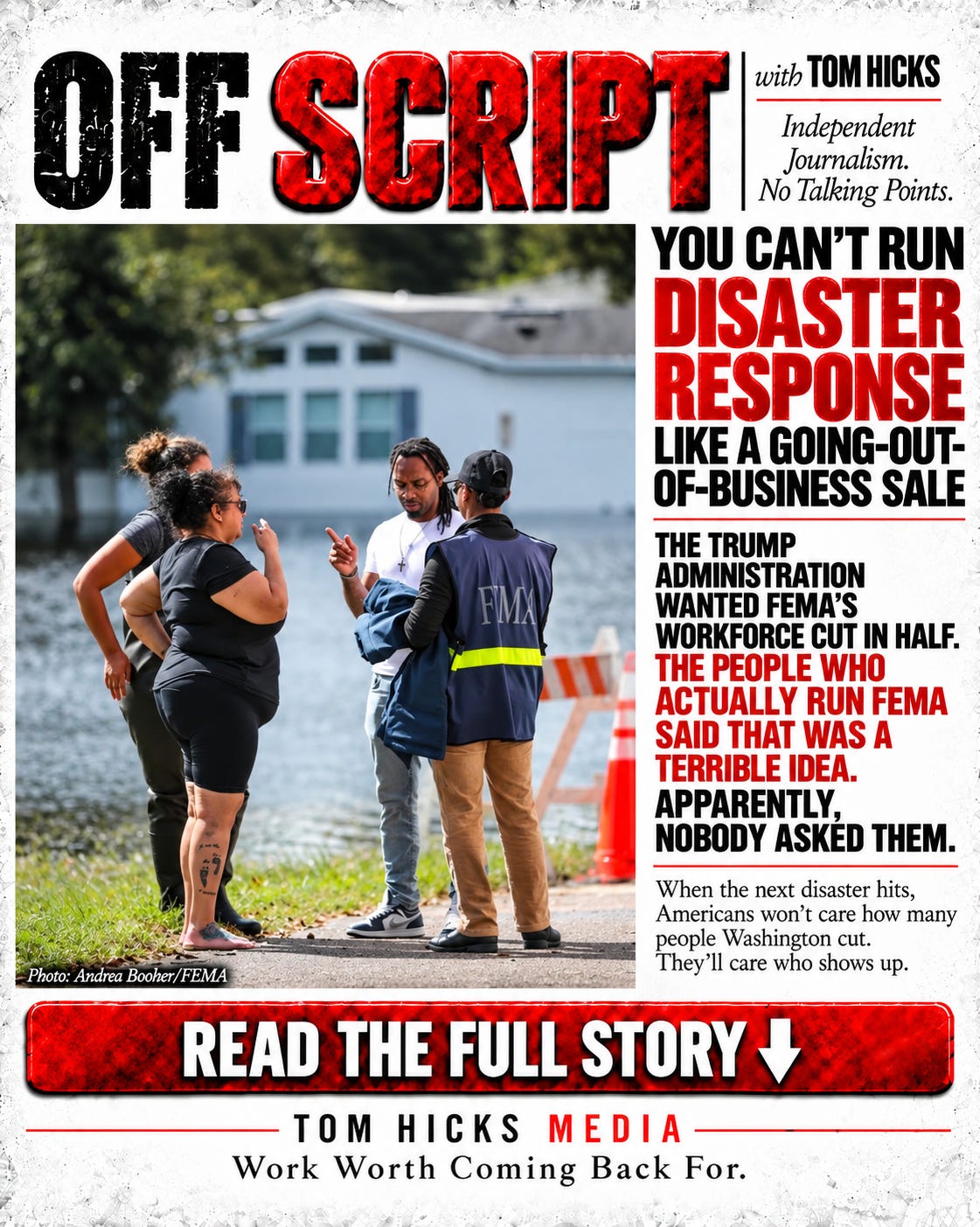
That appears to be roughly how the federal government arrived at a plan to cut the Federal Emergency Management Agency’s workforce by 50%.
Somebody picked 50%
U.S. District Judge Susan Illston ruled Friday that the Department of Homeland Security unlawfully took control of FEMA personnel decisions and pushed the agency toward a 50% workforce reduction. The remarkable part isn’t merely the size of the proposed cut. According to the record in American Federation of Government Employees v. Trump, FEMA’s own program and regional offices had already looked at their staffing needs and concluded the agency should remain at roughly 23,000 employees. DHS ultimately produced a staffing plan calling for about 11,383. Reuters
That’s a difference of roughly 11,600 human beings, and the government hasn’t produced some brilliant efficiency study explaining why half of FEMA suddenly became unnecessary. The Government Accountability Office reported that FEMA officials did not conduct an assessment of whether the workforce reductions and policy changes underway in 2025 and 2026 would damage the agency’s ability to respond to disasters. The people closest to the work said they needed roughly the workforce they already had, while the number moving through DHS went the other way. Government Accountability Office
This is where the usual argument about government bloat stops being particularly useful. Maybe FEMA has jobs that can disappear. Maybe it has offices that can be consolidated, processes that can be automated, and layers of management that somebody should have killed years ago. Fine. Show the work.
“Fifty percent” isn’t a management philosophy.
It’s a number.
Independent journalism needs independent readers
Your subscription helps fund reporting, research, publishing, new features, and the continued growth of every Tom Hicks Media publication.
Katrina was supposed to have taught us something
Congress didn’t leave FEMA’s structure entirely to presidential whim after Hurricane Katrina. The Post-Katrina Emergency Management Reform Act strengthened FEMA inside the Department of Homeland Security and placed limits on major reorganizations or transfers of the agency’s responsibilities and functions. Judge Illston concluded that DHS crossed those statutory lines when it effectively seized authority over FEMA staffing and pushed reductions without the congressional participation the law requires. Reuters
There’s an ugly historical irony buried in there. Congress imposed those protections because Katrina demonstrated what happens when emergency management becomes an organizational afterthought. Twenty years later, instead of arguing that those lessons were wrong and asking Congress to change the law, the administration tried to muscle through an enormous restructuring on its own.
That’s one of the habits becoming increasingly familiar in this administration. Treat a statute as an inconvenience, move first, and let a judge sort out the wreckage later. Sometimes the government wins those fights. Sometimes it loses. But when the subject is disaster preparedness, “we’ll find out in court” is a particularly stupid contingency plan.
FEMA had already been bleeding people
This fight also didn’t begin with a pristine, fully staffed FEMA waiting for somebody from Washington to sharpen a pencil. GAO found that about 17% of FEMA’s workforce left during 2025, taking experience and institutional knowledge with them. The watchdog warned that continued reductions without strategic workforce planning could hurt mission readiness and recommended that Congress require FEMA to make staffing decisions based on actual organizational needs. Government Accountability Office
Institutional knowledge is one of those phrases that sounds like bureaucratic mush until you need somebody who knows how to move thousands of generators, coordinate shelters, deal with overwhelmed state governments and navigate federal disaster rules while half the local infrastructure is lying in somebody’s swimming pool. You can replace a vacant chair. Replacing the person who knows what to do when everything has gone to hell is harder.
And FEMA doesn’t get its real performance review on a quiet Wednesday in Washington.
It gets one at 3 a.m. after a Category 4 hurricane comes ashore.
Then the messages started disappearing
The staffing decision would already deserve scrutiny if the story ended there. It doesn’t. During the litigation, DHS officials were found to have used Signal for communications concerning government business, with messages disappearing rather than being preserved for the case. Earlier proceedings in American Federation of Government Employees v. Trump specifically dealt with plaintiffs seeking those electronic communications from high-level decision-makers. Court filing
Judge Illston ultimately concluded that the missing communications could support an adverse inference against the government. Reuters reported that the court viewed the deleted Signal material as potentially unfavorable evidence concerning the staffing plan and DHS’s role in imposing it. In plain English, when evidence that should exist mysteriously doesn’t, a judge doesn’t have to pretend the disappearance means nothing. Reuters
That doesn’t prove every deleted message contained some smoking-gun confession. It doesn’t have to. Government officials making consequential public decisions have records obligations for a reason, and litigants have preservation obligations once those decisions land in court. If your policy is defensible, disappearing conversations about how it was created is a hell of a strange way to demonstrate that confidence.
The states can handle it. Until they can’t.
Trump has repeatedly talked about dramatically reducing FEMA’s role and pushing more responsibility for disasters onto the states. There’s a legitimate federalism debate hiding in there. State and local governments should be capable of handling emergencies that fall within their resources, and FEMA shouldn’t become the first phone call every time a tree falls over. Reuters
The problem is that disasters have an annoying habit of ignoring ideological theories about jurisdiction. A major hurricane can destroy infrastructure across several states. Wildfires don’t check whether the county budget has enough money before burning another 50,000 acres. Catastrophic flooding doesn’t give governors several fiscal years to build spare emergency-management capacity before the water arrives.
There’s a reason the federal government has a disaster-response agency. Some problems are larger than the governments closest to them can handle alone.
You can debate how large FEMA should be. You can debate what it should pay for, what responsibilities belong to states, and whether Washington has accumulated jobs it never should have taken. Those are policy arguments worth having.
But “half” isn’t a policy argument.
The test comes later
The most dangerous thing about cutting disaster preparedness is that the decision can look brilliant for months. Payroll falls. Headcount drops. Somebody puts a slide into a presentation showing taxpayers how many positions disappeared. Nobody notices the capability that disappeared with them because nothing terrible has happened yet.
Then something terrible happens.
By that point, you don’t rebuild an experienced emergency-response workforce between landfall forecasts. You don’t replace years of field knowledge with a patriotic hiring announcement. And you sure as hell don’t tell the family standing where its house used to be that the staffing model looked terrific in Washington.
Efficiency is supposed to mean accomplishing the mission with fewer wasted resources.
If you start by cutting the people and never determine whether the mission can still be accomplished, that isn’t efficiency.
It’s gambling.
And the chips belong to everybody else.
🔎 FROM OFF SCRIPT: THE BULLSHIT DETECTOR
The claim: “All” of the new jobs created under Trump have gone to American citizens.
Bullshit.
Vice President JD Vance pushed that line at this week’s Republican midterm convention, but the underlying employment numbers don’t support the sweeping claim. AP’s review found that the administration was using selective measures while native-born unemployment had also risen, turning a complicated labor market into a convenient campaign slogan. Associated Press Fact Focus
The claim: Foreign companies have committed more than $20 trillion in new U.S. investment.
Bullshit.
Trump repeated the figure at the convention, but documented commitments are nowhere close to $20 trillion. Even counting announcements generously doesn’t produce the president’s number. Apparently once you get past a few trillion, somebody figured nobody was still checking the receipt. Associated Press Fact Focus
The claim: Prices have fallen since Trump returned to office.
Bullshit.
Some individual prices have fallen, because individual prices always move in both directions. Overall consumer prices have continued rising, which is why voters remain pissed about the cost of living and why Republican speakers spent considerably more time talking about Democrats than explaining the grocery bill. Reuters
🐂 The Bullshit Detector
There’s plenty of bullshit out there. The point isn’t to complain about it. The point is to ferret it out.
The Bullshit Detector from Tom Hicks Media takes the same approach beyond the daily Off Script rundown: find the claim, check the evidence, and call it what it is.
Available for $4.95 from the Tom Hicks Media Store. Free to all paid subscribers.
More from Tom Hicks Media
Blind Spot
Sunday investigations and deeper reporting into the stories hiding underneath the daily headline.
Lotus Purrspective
Daily life, human behavior and household management explained by the tuxedo cat who is apparently in charge of all of it.
Tom’s Number Ones
Six charts. Six songs. One day in music history, plus the stories and memories hiding inside the numbers.
Panic Room Sports
Smart football coverage with attitude. Fantasy football, injuries, overreactions, and the occasional reminder that your waiver-wire savior is still somebody’s third-string running back.
Rabbit Ears Classic TV
The shows, stars, and strange little pieces of television history that made us keep adjusting the antenna.
The Backlot Ghost
Movies have ghosts. Some are on the screen. Some are buried in everything that happened before the camera rolled.
☕ Buy Me a Cup of Tea
If Off Script gives you something worth reading, arguing with, or forwarding to somebody who needs to see it, you can help keep the work going with a cup of tea.
Every bit helps fund the reporting, research, and publishing behind Tom Hicks Media.
One Question Before You Go
If FEMA can do its job with half the workforce, shouldn’t the government have to prove that before cutting it in half?

#FEMA #DHS #TrumpAdministration #EmergencyManagement #GovernmentAccountability #IndependentJournalism #OffScriptWithTomHicks