

By Tom Hicks | September 26, 2026
Editorial Note:
Off Script with Tom Hicks is independent journalism. No party talking points. No manufactured outrage. Just the facts, the context, and an opinion once the evidence earns one.
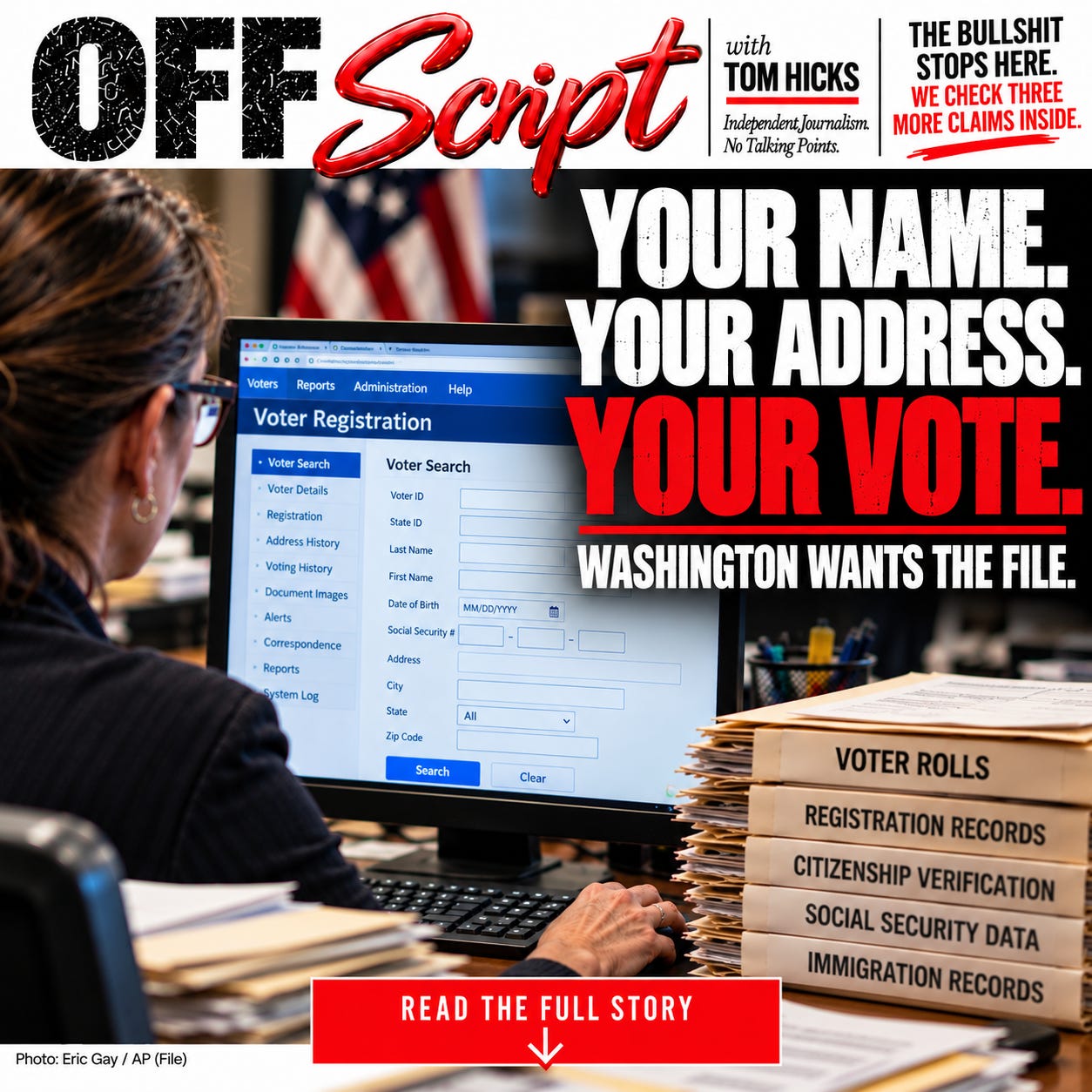
There is a legitimate question underneath the Trump administration’s latest election push: Are noncitizens illegally voting in American elections? Yes. It happens, and pretending otherwise only makes it easier to dismiss legitimate concerns about election security.
But that’s the easy question. The harder one is whether it happens often enough to justify building a federal system capable of checking millions of American voters against government databases containing immigration and Social Security information. That’s where this stops being a simple argument about keeping voter rolls clean and becomes something much larger.
On Friday, the Supreme Court allowed the Trump administration to resume using an expanded version of the federal SAVE database for mass citizenship checks of registered voters. SAVE, short for Systematic Alien Verification for Entitlements, has existed for years, but its reach has changed dramatically. The revamped system connects immigration records with Social Security Administration data and allows election officials to run large batches of voters through it using Social Security numbers and other identifying information. Reuters
And SAVE isn’t operating in isolation. The Justice Department has been trying to obtain state voter files, while DHS has obtained some form of voter-roll data from at least 47 states. Put those pieces together, and we’re no longer talking only about catching the occasional person who shouldn’t be voting. We’re talking about the federal government assembling an extraordinary amount of information about the people who do. Reuters
That’s the story.
Not whether noncitizens should vote. They shouldn’t. And not whether voter rolls should be accurate. They should.
The story is how much information the federal government should be allowed to collect about millions of lawful voters while looking for the comparatively small number of people who don’t belong on those rolls.
WHAT THE SUPREME COURT ACTUALLY DID
The case is Department of Homeland Security v. League of Women Voters, and one distinction matters immediately. The Supreme Court did not issue a final ruling declaring every part of the expanded SAVE program legal. It stayed a lower-court judgment while the appeal continues, which allows the administration to use the expanded system in the meantime.
The Court’s six conservative justices granted the administration’s request. Justices Ketanji Brown Jackson, Sonia Sotomayor and Elena Kagan dissented. The majority concluded that the challengers were unlikely to prevail on their argument that federal law prohibited the Department of Homeland Security from obtaining citizenship information from the Social Security Administration. Supreme Court
The lower court had reached a very different conclusion. U.S. District Judge Sparkle Sooknanan found that the revamped system violated federal law and relied partly on citizenship information that could be outdated. The D.C. Circuit declined to stay her ruling before the administration went to the Supreme Court, setting up Friday’s decision allowing the system to operate while the legal fight continues. Reuters
Jackson’s dissent gets to the practical problem underneath the legal fight. Social Security records can contain outdated citizenship information, meaning someone who later became a naturalized American could still appear in older records as a noncitizen. Once a government database becomes part of determining whether somebody belongs on a voter roll, stale information isn’t an abstract technical problem. It can put a perfectly legal voter on the wrong side of a government screen. Supreme Court
If reporting like this is worth having in your inbox, subscribe to Off Script with Tom Hicks.
Free readers get the daily edition, and paid subscribers help keep independent work like this going, plus the Blind Spot every Sunday.
WHEN THE DATABASE GETS IT WRONG
And we already know the database gets things wrong.
According to filings cited by Reuters, an election official in Travis County, Texas, reported that 25 percent of SAVE matches identifying possible noncitizens involved people who had already demonstrated that they were U.S. citizens. In St. Louis County, Missouri, news reports cited in the litigation found that at least 81 percent of SAVE responses examined there were erroneous. The overall error rate of the expanded system has not been publicly disclosed. Reuters
Nobody should need a party registration to see the problem. A database match isn’t proof that somebody committed a crime or even proof that the person is ineligible to vote. Sometimes it means the government has old information, incomplete information, or information attached to the wrong person. That’s annoying when a database screws up your mailing address. It’s something else entirely when the database is helping decide whether you get to vote.
Now scale that problem across millions of records.
The Justice Department has spent months trying to obtain state voter files containing sensitive identifying information. Reuters reported Friday that DOJ has lost 25 lawsuits attempting to compel states to surrender complete voter rolls, while the administration maintains that federal law gives it authority to inspect election records to ensure voter lists are properly maintained. Reuters
The Justice Department’s Office of Legal Counsel has concluded that federal law allows DOJ to compel statewide voter-registration lists and share those records with DHS so they can be checked against federal databases. Meanwhile, DHS has obtained some form of voter-roll data from at least 47 states, although it remains unclear how many of those files contained complete personal information rather than public or redacted records. Department of Justice Reuters
Then there’s another piece that deserves more attention: commercial data.
DHS is also using information from a commercial data broker to supplement government records. That leaves us with state voter information, federal immigration records, Social Security information, and commercially collected data all feeding an effort to determine who belongs on voter rolls. Whatever you think about the administration’s intentions, that’s a hell of a lot of machinery. Reuters
So let’s ask the obvious question.
How big is the problem all this machinery is supposed to fix?
THE FRAUD IS REAL. THE SCALE MATTERS.
Noncitizens have illegally voted in American elections. There have been prosecutions, and anyone who knowingly casts a ballot without being legally eligible should face the consequences. States also have an obligation to correct registration mistakes and maintain accurate voter rolls.
But anecdotes don’t tell us the size of a problem. Numbers do.
A Reuters examination of federal court records found relatively few prosecutions under the federal law prohibiting noncitizen voting compared with the enormous number of votes cast in American elections. The cases Reuters examined also did not reveal the kind of coordinated operation that would support claims of widespread organized noncitizen voting. That’s a real problem deserving enforcement. It isn’t evidence of the enormous illegal-voting operation Trump has repeatedly described. Reuters
There is another number we shouldn’t ignore simply because it complicates the story. Reuters found that software glitches and clerical mistakes across multiple states have resulted in noncitizens being mistakenly added to voter rolls. How many of those people actually cast ballots is a separate question, and registration errors themselves don’t establish intentional voter fraud. Fix the damn systems. Reuters
That’s the line worth holding. Prosecute intentional illegal voting. Fix software that registers people who aren’t eligible. Clean voter rolls using reliable information and give eligible citizens a meaningful way to correct mistakes.
None of that requires pretending the evidence says something it doesn’t.
HOW MUCH POWER ARE WE BUILDING?
The administration says this is about election integrity. Critics say inaccurate mass matching could remove eligible voters, particularly naturalized citizens whose federal records haven’t caught up with their citizenship status. Both arguments can be tested against what the system actually does and how accurately it does it. Reuters
But there’s a larger question that tends to disappear whenever politics becomes tribal.
Forget Donald Trump for a minute. Would you want the next Democratic president to inherit this system? How about the president after that?
Government powers rarely disappear when the politician who created them leaves office. Once Washington has built the infrastructure to combine voter records with immigration information, Social Security data, and commercially collected information, the important question isn’t whether you trust the current president.
It’s whether you trust the power.
SIX WEEKS BEFORE AMERICA VOTES
The timing makes all of this harder to dismiss as bureaucratic housekeeping. Americans vote in the midterms on November 3, with control of Congress at stake, and the administration is expanding its voter-verification machinery in the final weeks before that election. Trump has spent years claiming noncitizen voting is widespread, while the available evidence shows illegal voting by noncitizens occurs but has not established fraud on the scale he alleges. Reuters
That doesn’t prove some secret plan to steal an election, and we don’t need one to make this story matter. A government system this powerful deserves scrutiny even if everyone operating it has perfectly honorable intentions. We should know how accurate it is, who gets access to the information, how long the data are retained and what happens to an eligible citizen when the government’s computers get it wrong.
Because “trust us” isn’t a safeguard.
THE REAL TEST
Election integrity matters. So does the integrity of the machinery used to protect it.
There is nothing unreasonable about checking voter rolls for people who have died, moved away, or aren’t legally eligible to vote. That’s basic election administration. But when the government moves from maintaining voter rolls to assembling federal systems capable of comparing millions of Americans against enormous stores of personal information, citizens have every reason to start asking harder questions.
How accurate is it? Who gets access? What prevents the information from being used for purposes having nothing to do with voter eligibility? And when the machine gets an American citizen wrong, who carries the burden of fixing it?
Those aren’t questions for Republicans or Democrats. They’re questions for anyone who has ever watched government ask for a little more information and promise it’ll only use it for one thing.
This time, the file has your name, your address and your vote attached to it.
THE BULLSHIT DETECTOR
CLAIM: “54% of North Carolina commercial driver’s licenses were issued illegally to foreign nationals.”
BULLSHIT: Somebody turned a small inspection sample into half a state.
WHY: Federal inspectors examined a sample of 50 commercial driver’s licenses issued to noncitizens and found problems with 27, producing that eye-popping 54 percent. North Carolina then reviewed its complete pool of more than 325,000 active CDLs and found 1,149 licenses issued incorrectly to noncitizens, about 0.35 percent of all active CDLs. State officials also said none of those drivers were in the country illegally. PolitiFact
CLAIM: Trump is trying to put his name on Ford’s Theatre, where Abraham Lincoln was assassinated.
BULLSHIT: Apparently the internet decided Washington didn’t have enough naming fights already.
WHY: There is no evidence Trump is trying to rename Ford’s Theatre or add his name to the historic site. The claim originated as satire and then traveled through social media without the joke attached, which is apparently how we manufacture breaking news now.
CLAIM: Australian Prime Minister Anthony Albanese recycled an old photo with Trump and pretended it was taken at this week’s U.N. General Assembly.
BULLSHIT: The smoking gun was Trump’s necktie.
WHY: Critics decided the selfie must be old because Trump appeared wearing a different tie in other images from the day. AFP checked the timeline and imagery and found that the photo was taken during this week’s U.N. gathering. Trump changed his tie. Sometimes haberdashery really is just haberdashery. AFP Fact Check
MORE FROM TOM HICKS MEDIA
Panic Room Sports
Smart football coverage with attitude. Everyone reacts. We’ll check the tape first.
Tom’s Number Ones
Six charts. One date. The music that owned America.
Rabbit Ears Classic TV
Television when everybody watched the same thing and argued about it the next morning.
The Backlot Ghost
Classic movies, forgotten stories and the things Hollywood left behind.
Lotus Purrspective
Life, humans and their questionable decisions, reviewed by a tuxedo cat.
BUY ME A CUP OF TEA
Off Script doesn’t have corporate sponsors telling it what not to say. If you value independent work like this and want to help keep it going, Buy Me a Cup of Tea. Every cup helps.
ONE QUESTION BEFORE YOU GO
How much access should the federal government have to voter information in the name of election security?
Off Script with Tom Hicks would like your perspective. Drop your answer in the comments.

#OffScript #VotingRights #Election2026 #VoterData #SupremeCourt