
Tom Hicks | October 25, 2026
Editorial Note:
This is the third installment of Blind Spot: The Election Before the Election, a four-part investigation from Off Script examining what happens to American elections beyond the campaign speeches and television coverage. The entire series is free through Election Day, November 3. No paywall. No party line. Just the machinery, the people, and the evidence.
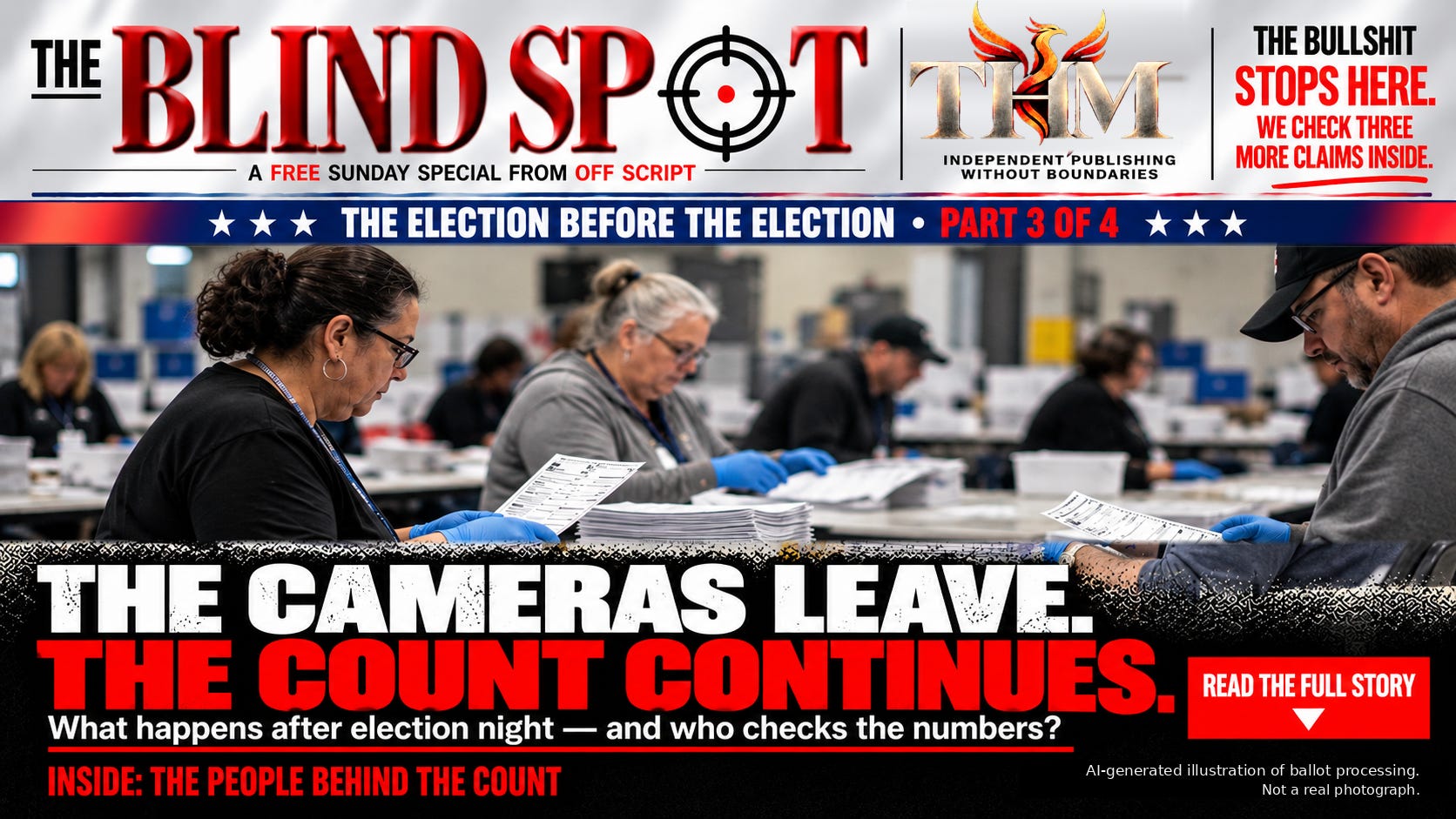
You’re going to see a lot of numbers on election night. They’ll appear on television screens, crawl across websites, and change while people with expensive haircuts explain what those changes supposedly mean. At some point, a network will project a winner, somebody will celebrate, somebody else will complain, and much of the country will assume the counting is finished.
It won’t be.
In fact, some of the most important work in an American election happens after the television cameras have moved on to something else. It’s done in county offices, municipal buildings, warehouses, and rooms where people sit with stacks of ballots, computer printouts, reconciliation forms, and enough procedural rules to make a tax accountant reconsider his career choices.
Those people rarely make the news unless something goes wrong.
I’ve always found that peculiar. We spend billions of dollars arguing about who should hold public office, then pay remarkably little attention to the people responsible for making sure the votes are recorded and counted correctly. When their work becomes controversial, we suddenly expect everyone to understand an enormously complicated process that we’ve largely ignored for years.
With the November 3 midterms approaching, that gap matters. Election officials are preparing for ordinary counting problems, cybersecurity threats, politically charged allegations, and concerns about the safety of their own employees. The question isn’t whether anyone should examine their work. Of course they should.
The question is whether we’re prepared to distinguish actual scrutiny from suspicion dressed up as evidence.
The election doesn’t end when somebody calls it
Here’s something worth remembering when a television graphic announces that 100% of precincts have reported: That number does not mean every valid ballot has been counted or that the results are certified.
The U.S. Election Assistance Commission explains that election-night totals are preliminary. They can change as valid mail ballots, provisional ballots, military and overseas ballots, and other eligible votes are added under the applicable state rules. A network’s projection is a journalistic determination. Certification is a separate legal process carried out by election authorities.
That distinction sounds straightforward until a closely watched race starts shifting after midnight.
Imagine watching a candidate lead by several thousand votes, then seeing the margin narrow as another county reports. Without knowing how those ballots were processed, the change might look suspicious. Someone online posts a screenshot of the earlier total, circles the later one in red, and announces that votes have appeared from nowhere.
Except that new votes appearing in reported totals is precisely what happens when additional ballot batches are counted and reported.
Different jurisdictions have different rules about when they can begin processing mail ballots, how they handle provisional ballots, and which ballots can legally arrive after Election Day. The EAC’s explanation of changing election results makes clear that those differences can affect both the speed of counting and the order in which different categories of votes are reported.
None of this means every discrepancy is harmless. Errors occur. A batch can be reported incorrectly. Equipment can malfunction. Procedures can be challenged. The responsible response is to document the problem, determine what happened, and correct it under the applicable law.
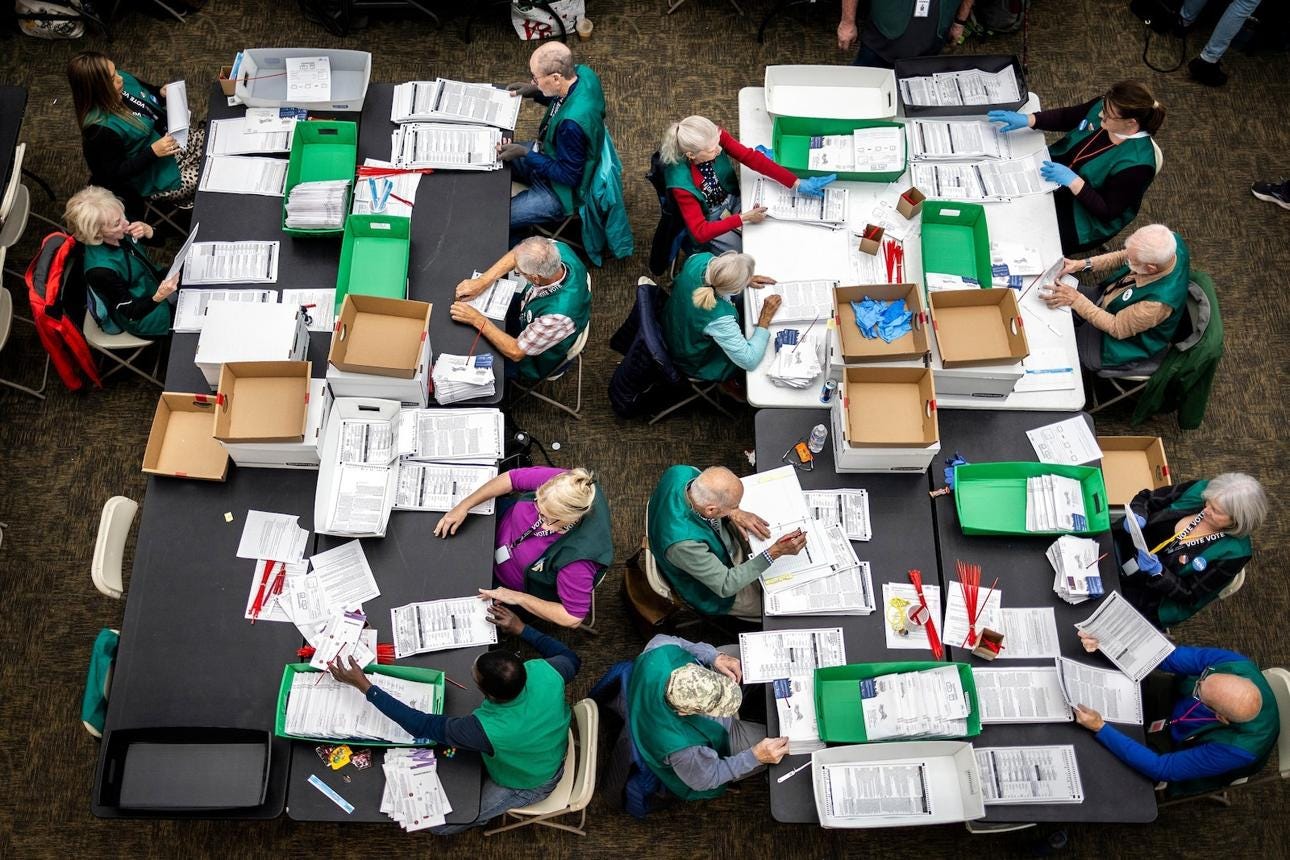
Election workers process ballots during the November 2024 election. Associated Press photo via ABC News.
What matters is the evidence supporting the explanation.
And that’s where the people doing the counting come in.
The people behind the numbers
In the 2024 general election, more than 772,000 Americans worked at polling places. According to the Election Assistance Commission, nearly 48% of election jurisdictions reported difficulty recruiting enough people to do the job. Many of those workers were older Americans, and a large number of jurisdictions depended on people willing to devote long hours to work that attracts far more criticism than applause.
Those figures come from the EAC’s Election Administration and Voting Survey. Poll workers aren’t necessarily the same employees who tabulate and certify results, but they belong to the larger workforce that keeps elections functioning.
Some work the registration tables. Others help voters navigate equipment, assist people with disabilities, manage ballot materials, or reconcile records. Additional staff handle mail ballots, operate counting equipment, investigate discrepancies, and prepare the documentation used to establish official totals.
The important point is that an election is not the work of one person sitting behind a computer deciding which numbers look best. It involves people performing different duties under procedures established by state and local law, with records and opportunities for review.
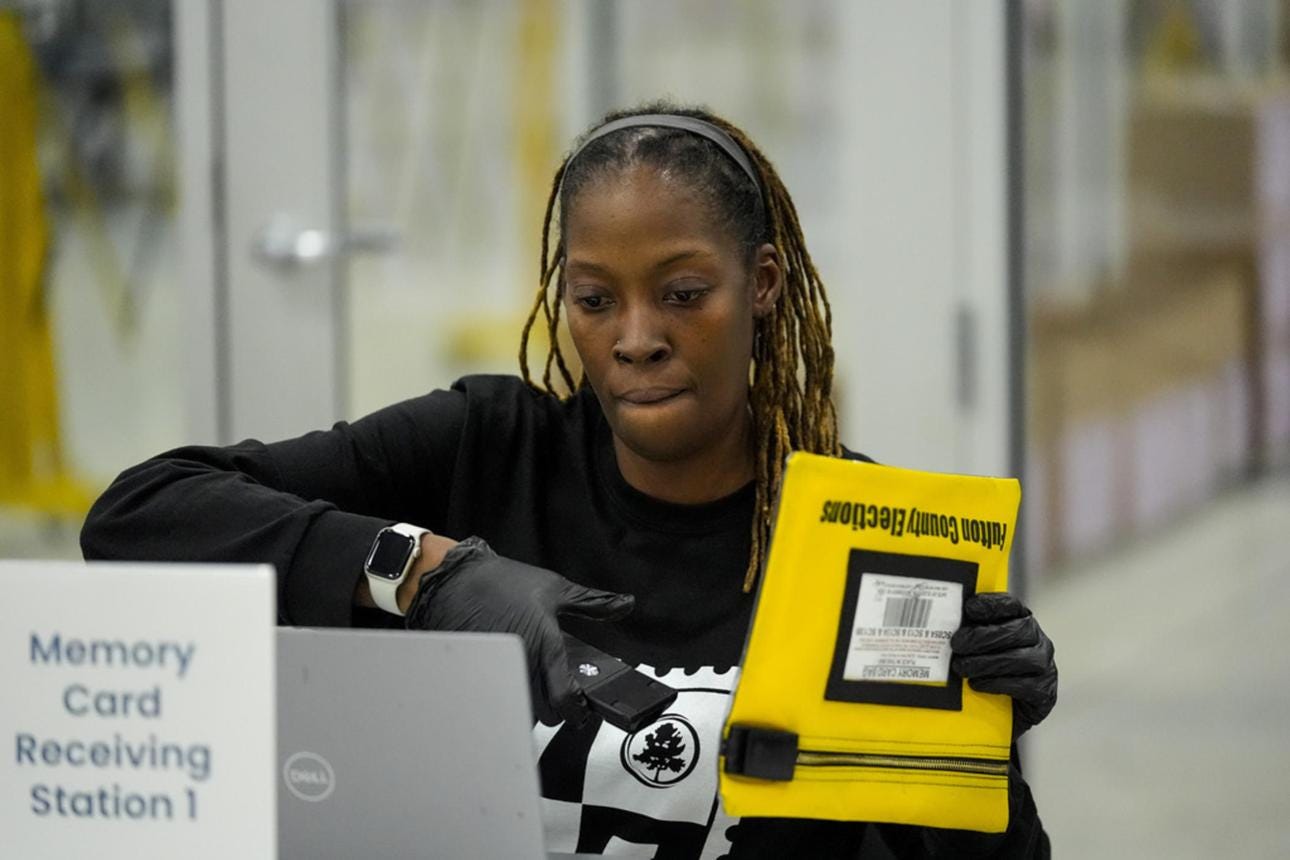
An election worker processes a secured voting-equipment memory card at Fulton County’s election operations center in Georgia during the 2024 election. Associated Press photo via Georgia Public Broadcasting.
Consider the difference between counting ballots and certifying an election. Once ballots have been tabulated, election officials undertake what’s called a canvass. That involves reconciling the records: how many voters participated, how many ballots were issued or received, how many valid ballots were counted, and whether discrepancies need to be resolved.
The Congressional Research Service’s October 19 report describes the different layers of review involved in finalizing federal election results. Procedures vary by jurisdiction, and certification generally follows the completion of legally required counting and review steps.
That is painstaking work. It is also the sort of work that becomes invisible when it is done correctly.
And these days, the people doing it have considerably more on their minds than arithmetic.
When the job comes with threats
In April, the Brennan Center for Justice published its 2026 survey of local election officials. The findings offer a rather uncomfortable picture of what election administration has become.
32%
Reported threats, harassment, or abuse
50%
Worried about political interference
75%
Reported no added state/local resources to offset federal security-service cuts
Brennan Center’s April 2026 survey of local election officials. Percentages describe surveyed officials’ reported experiences and concerns, not verified incidents in every election jurisdiction.
Read those first two figures again. Nearly a third of surveyed officials reported having been threatened, harassed, or abused, while half were worried about political leaders interfering with their work.
Those aren’t allegations that the election itself has been compromised. They’re descriptions of the working conditions and concerns reported by the officials responsible for administering it.
On October 15, the FBI issued a public warning about threats against election workers, noting that such threats can be delivered by telephone, email, social media, or in person. It urged people to report potential threats and preserve available evidence.
It’s worth considering what this does to a job that already requires considerable concentration. An election worker may have to resolve a ballot-processing question, complete official paperwork, explain a rule to an observer, and deal with someone convinced that the entire operation is crooked before a single piece of evidence has been examined.
That’s a lousy environment for accuracy.
There is a legitimate reason to question government officials. They work for the public, and their decisions should withstand inspection. Election administrators have no special exemption from that principle. Mistakes deserve correction, misconduct deserves investigation, and the legal safeguards surrounding elections are supposed to be tested rather than simply admired.
But a threat isn’t an audit. Harassing an employee doesn’t establish that a ballot was mishandled. Accusing someone of a crime without evidence doesn’t make the process more transparent.
It creates one more problem for the people trying to do the work.
The machines aren’t supposed to be taken on faith
One of the more consequential election-security stories this month came from Reuters.
Its October 2 investigation examined a federal effort to investigate allegations that foreign actors manipulated voting equipment and altered the 2020 election. Reuters reported that technical examinations identified vulnerabilities, but investigators had not established the alleged hacking, vote manipulation, or connections between voting systems that had been proposed.
Those two findings need to be understood separately.
A vulnerability in election equipment matters. It may require additional testing, mitigation, replacement, or an investigation into whether anyone exploited it. Election officials and security researchers have been examining weaknesses in voting technology for years.
Finding a vulnerability, however, does not automatically establish that somebody used it to alter votes in an actual election.
That’s a distinction worth defending regardless of which candidate is complaining.
Just this week, the Associated Press reported on allegations involving touchscreen voting machines that appeared to select candidates differently from what some voters intended. The October 23 reporting described how election officials were responding to those complaints, including explanations involving screen calibration or inadvertent touches. Officials reported no unusual increase in such complaints.
A malfunction should be reported and addressed. If a ballot-marking device produces a paper ballot that doesn’t reflect the voter’s selections, the voter should seek assistance before casting it. That’s precisely why the ability to inspect a paper record matters.
What the available evidence doesn’t support is treating every malfunction as proof of an organized effort to change election results.
Nor should election officials expect the public to accept an unexplained discrepancy merely because someone behind a desk says everything is fine.
Confidence has to come from procedures people can examine.
The audit is where the argument gets interesting
Think of a business that closes its books at the end of the month. The accounting software produces a total, but somebody still has to check the supporting records and look for errors. If the numbers don’t agree, the accountant doesn’t get to announce that math has been canceled.
Elections have analogous procedures, although the stakes and legal requirements are different.
The National Conference of State Legislatures updated its report on post-election audits on September 24. It reports that every state and Washington, D.C., conducts some form of post-election audit, with considerable differences in requirements, methods, and timing. Thirty-one states and D.C. require post-election audits before certification.
Some jurisdictions use traditional audits that hand-count a predetermined sample of ballots. Others use risk-limiting audits, which apply statistical methods to test whether the reported outcome is supported by the underlying paper records. A close contest can require more extensive examination.
The MIT Election Lab’s explanation makes an important distinction: the risk limit in a risk-limiting audit is a statistical safeguard governing the audit procedure. It is not the estimated probability that a particular election result is wrong.
And audits have limitations. They differ in scope, some occur after certification, and they depend on trustworthy records and proper procedures. They are useful evidence about the count, rather than a magical guarantee that no administrative mistake could ever have occurred.
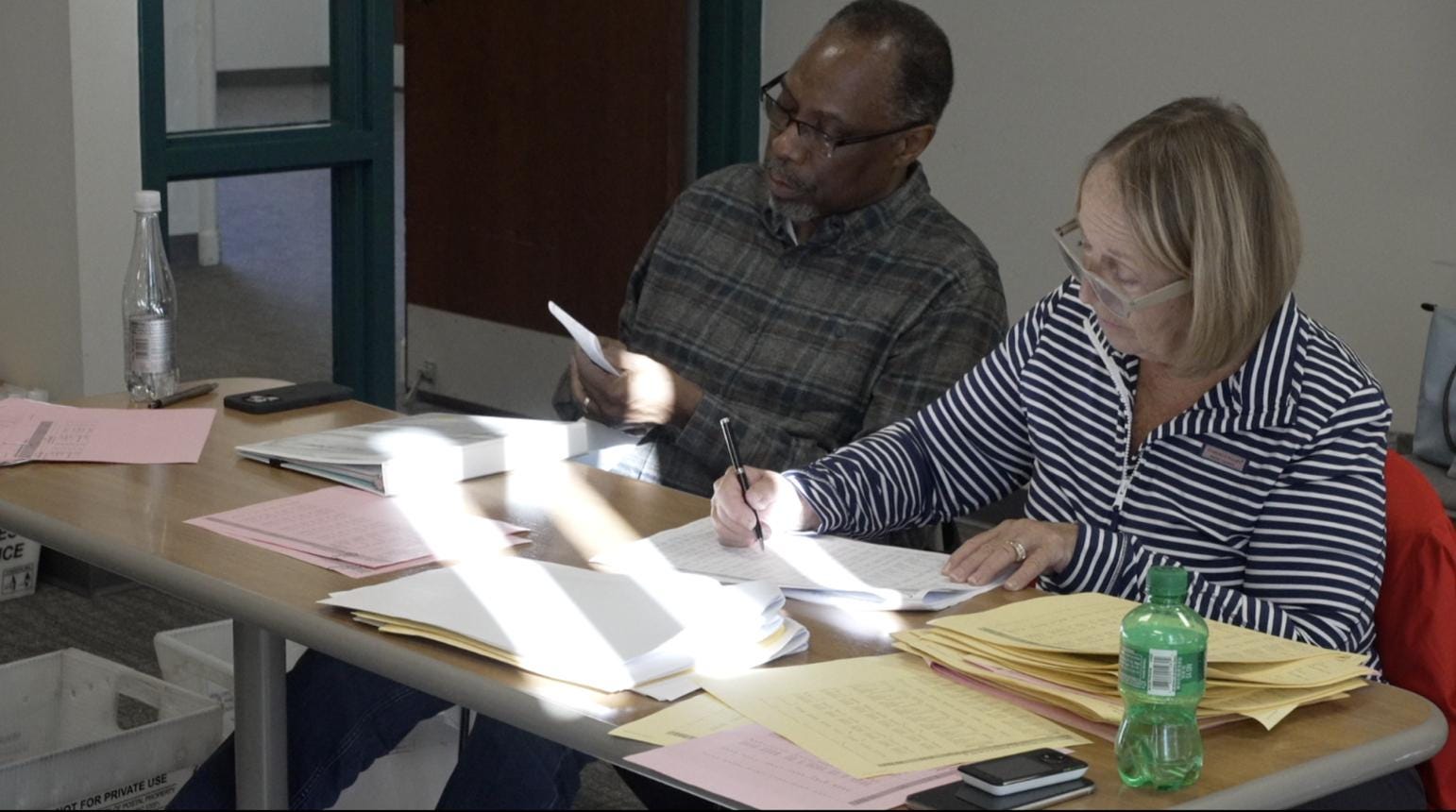
Members of the Ingham County Board of Canvassers in Michigan review election records following the November 2024 election. Photo via FOX 47 News.
Election observers are another part of the picture. Depending on state law, political parties, candidates, nonpartisan organizations, and sometimes members of the public can observe different parts of election administration.
According to the Election Assistance Commission’s guidance on observers, their function is to monitor the process while respecting voter privacy and avoiding disruption. Certain jurisdictions also allow formal ballot or voter challenges under specified rules.
That right to observe matters. So do the boundaries around it. The public has an interest in seeing that the work is being performed properly, and the people doing the work need to be able to complete it.
There is nothing contradictory about those two requirements.
The pressure doesn’t stop at the county line
There’s another development worth watching before November 3, and it concerns the relationship between Washington and the people who actually administer elections.
Under the American system, state and local governments bear primary responsibility for conducting elections, including federal contests. Washington has legitimate roles involving voting rights, security assistance, enforcement of federal laws, and investigations of possible crimes. How far those powers extend in particular circumstances is a question of law, and disputes can end up in court.
Reuters reported on September 15 that election officials from both parties were preparing for possible federal interventions, including requests for voting equipment and records, investigations, and legal challenges. Some had hired attorneys or prepared staff to respond to subpoenas and other government demands. The Reuters investigation was based on interviews with more than 50 officials. Those preparations establish that officials are concerned; they do not establish that the scenarios they anticipate will occur.
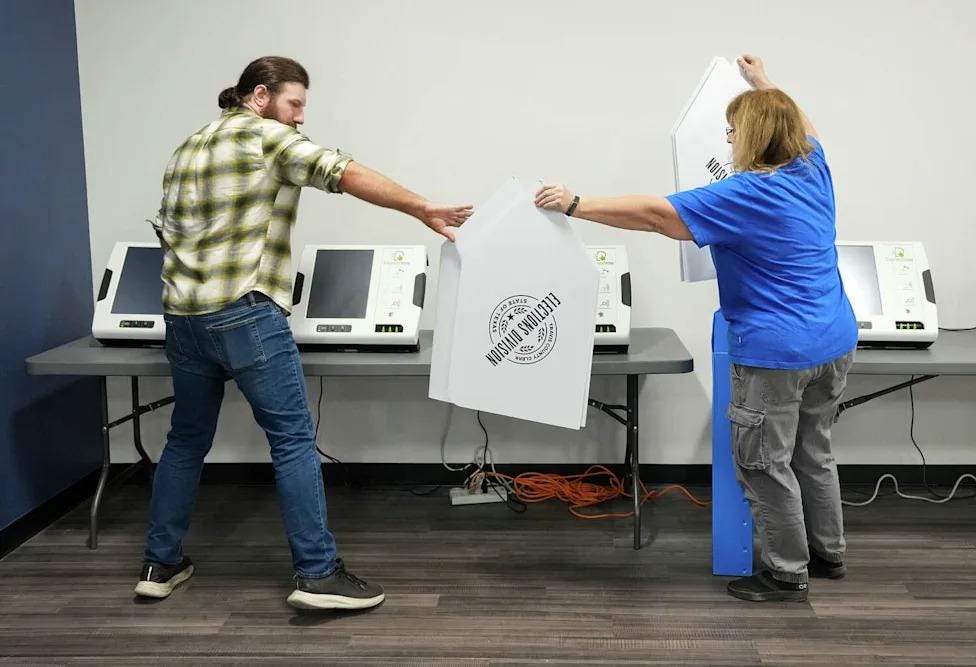
Election technicians prepare voting equipment in Austin, Texas, ahead of the 2026 midterm elections. Photo via Austin American-Statesman.
The Trump administration has emphasized combating election fraud and foreign interference as priorities. Federal agencies have also issued warnings about cyber threats, including an October 16 FBI and CISA alert concerning more convincing phishing attempts aided by artificial intelligence.
There are real security questions here. Federal assistance can help local jurisdictions confront threats they cannot manage alone. Federal investigations can uncover wrongdoing. At the same time, investigations involving election records or equipment require clear legal authority, careful evidence handling, and attention to the potential impact on ongoing election operations.
The relevant standard should remain the same no matter who occupies the White House or which party controls a state election office.
What authority is being exercised? What evidence supports the action? What safeguards govern it? And what can the public independently verify?
Those questions are considerably more useful than deciding, in advance, that every government intervention must be either a rescue operation or a conspiracy.
The one thing election night television can’t give you
Earlier this month, the Bipartisan Policy Center published a survey of 3,144 registered voters conducted in September. Its findings showed that most respondents remained confident that votes would be counted as intended, although confidence and concerns differed by political affiliation and voting method.
A separate Pew Research Center survey released October 20 found that 79% of registered voters were confident that in-person ballots nationwide would be counted as intended. Confidence in the counting of absentee and mail ballots stood at 53%.
Those figures deserve attention because they reveal a significant difference between the public’s confidence in various voting methods. They don’t, by themselves, establish whether those methods are being administered accurately. Public opinion measures what people believe. Election records, audits, and investigations provide evidence about what actually happened.
We should be able to keep those things separate.
If a county reports a discrepancy, the public should be able to learn what went wrong and how officials addressed it. If an audit discovers a significant problem, there should be a documented process for expanding the examination or correcting the count. If someone alleges fraud, the allegation deserves an examination appropriate to the evidence, not automatic acceptance or automatic dismissal.
And when officials certify an election, the public should understand which legal requirements have been satisfied and where the supporting records can be found.
The people counting the votes should expect to answer difficult questions. They should also be entitled to do their jobs without intimidation.
Two Sundays ago, this series examined the rules that determine who gets to vote. Last Sunday, we looked at how political boundaries and election structures influence the weight of those votes.
Now we’ve reached the part that should be straightforward but has become remarkably contentious: making sure valid votes are counted correctly and that the result can be demonstrated with evidence.
The people responsible for that work aren’t infallible. Neither are the politicians questioning them, the commentators interpreting the numbers, or the rest of us watching from home.
That’s why records, independent checks, and enforceable procedures matter.
On election night, someone will tell you who won. Over the following days, the people responsible for the official result will have to establish what the count actually shows.
It’s worth knowing who those people are before somebody decides they’re the enemy.
If this was worth your time, hit Like, Restack or share it. That’s how independent work like this finds new readers.
Keep Reading Off Script / Blind Spot
This election series is free through Election Day. Next Sunday, November 1, we’ll finish with The Final Week’s Dirty Tricks—the misleading messages, last-minute claims, and other attempts to create confusion before voting ends.
You can subscribe for free and keep reading the investigations and daily reporting, or become a paid subscriber to help support the work that goes into researching and checking each edition. Either way, I’m glad you’re here.
The Bullshit Detector
Three claims that deserve a closer look this week. None has anything to do with the main investigation, and each has been checked against the available evidence.
💩 Misleading · 💩💩 Distorted · 💩💩💩 False
💩💩💩💩 Fabricated/manipulative · 💩💩💩💩💩 Potentially serious harm
1. The Tesla Roadster that supposedly jumped off the Golden Gate Bridge
Claim: A spectacular new video shows a Tesla Roadster launching itself off the Golden Gate Bridge, using its thrusters, and returning safely to the roadway.
Bullshit: 💩💩💩
Why: The footage wasn’t a real bridge stunt. A Lead Stories investigation published October 23 found no supporting news coverage of the alleged event and reported that an AI-detection tool identified the footage as overwhelmingly likely to be generated. Tesla had unveiled an unusual Roadster demonstration in Texas, but that was a different event. The viral clip apparently decided that reality wasn’t sufficiently entertaining.
2. Zelenskyy’s supposed $42 million Canadian nuclear bunker
Claim: The Toronto Sun reported that Ukrainian President Volodymyr Zelenskyy purchased a $42 million underground nuclear bunker in Nova Scotia.
Bullshit: 💩💩💩💩
Why: The publication denied reporting the story. The supposed article appeared on an imitation website registered shortly before the claim circulated. Lead Stories contacted the newspaper directly, and its deputy editor confirmed that the article was fake. The alleged property purchase also lacked independent corroboration. Impersonating a newspaper to circulate a claim about a wartime leader gives this considerably more potential for manipulation than an ordinary mistaken social-media post.
3. The heartwarming polar bear rescue that never happened
Claim: A viral video shows a man rescuing an injured polar bear cub, nursing it back to health, and eventually releasing it into the wild.
Bullshit: 💩💩
Why: The original creator identified the video as AI-generated. When it circulated elsewhere, the fictional rescue was presented as an authentic event. Lead Stories traced the footage to the creator’s account and verified the AI labeling. Nobody needed to fabricate a heartwarming animal rescue story, but apparently even polar bears aren’t safe from the engagement business.
A brief interruption to introduce someone new
We’ve added a new voice to the Tom Hicks Media family, and he appears to have arrived already irritated with most of civilization.
Meet Frank N. Krancke. His debut column, I’ve Had It Up to Here With You People. And I’m Not That Tall, begins with the surprisingly complicated business of buying a goddamn lightbulb. Apparently, civilization can build computers sophisticated enough to help run an election, but asking for something that lights up the kitchen now requires a seminar in electrical engineering. Frank has thoughts. Several of them are printable.

More From Tom Hicks Media
If you’d like something considerably less political after that investigation, Chart Collision revisits the songs and stories that shaped our lives, while Rabbit Ears Classic TV goes wandering through the shows, characters, and television memories that refuse to leave us alone. The Backlot Ghost handles the movie side of that nostalgia, including the films that were better, stranger, or more memorable than anyone expected.
For an entirely different perspective, Lotus Purrspective offers household observations from a tuxedo cat who considers herself the only competent resident. What The Hell? specializes in the moments when history proves that human beings have been doing spectacularly stupid things for centuries, and Panic Room Sports takes its own skeptical look at the games, the hype, and the people paid handsomely to explain both.
Come argue with us
We also have a Tom Hicks Media Discord server, where the conversations don’t have to end when the article does. Politics, music, movies, television, and whatever else wanders into the room. Bring an opinion. Bring evidence if you’re making factual claims. Coffee is optional.
Join the Tom Hicks Media Discord
Buy Me a Cup of Tea
Independent reporting takes time, especially when the goal is to find out what actually happened instead of repeating whatever appeared on social media five minutes ago. If you’d like to help keep this work going, you can buy me a cup of tea. Every little bit helps.
One Question Before You Go
What would give you the most confidence in a close election result: seeing the audit records, watching the counting process, understanding who certifies the result, or something else entirely?
I’m particularly interested in what you would consider convincing evidence—and whether that standard would remain the same regardless of which candidate won.
#BlindSpot #OffScript #Election2026 #MidtermElections #ElectionIntegrity #ElectionWorkers #VoteCounting #IndependentJournalism #TomHicksMedia