

EDITOR’S NOTE: Welcome to the Blind Spot, the series where we take something hiding in plain sight, turn it over, and see what falls out. Sometimes the biggest stories aren’t about what somebody is hiding from us. They’re about what we’ve walked past a thousand times without ever noticing.
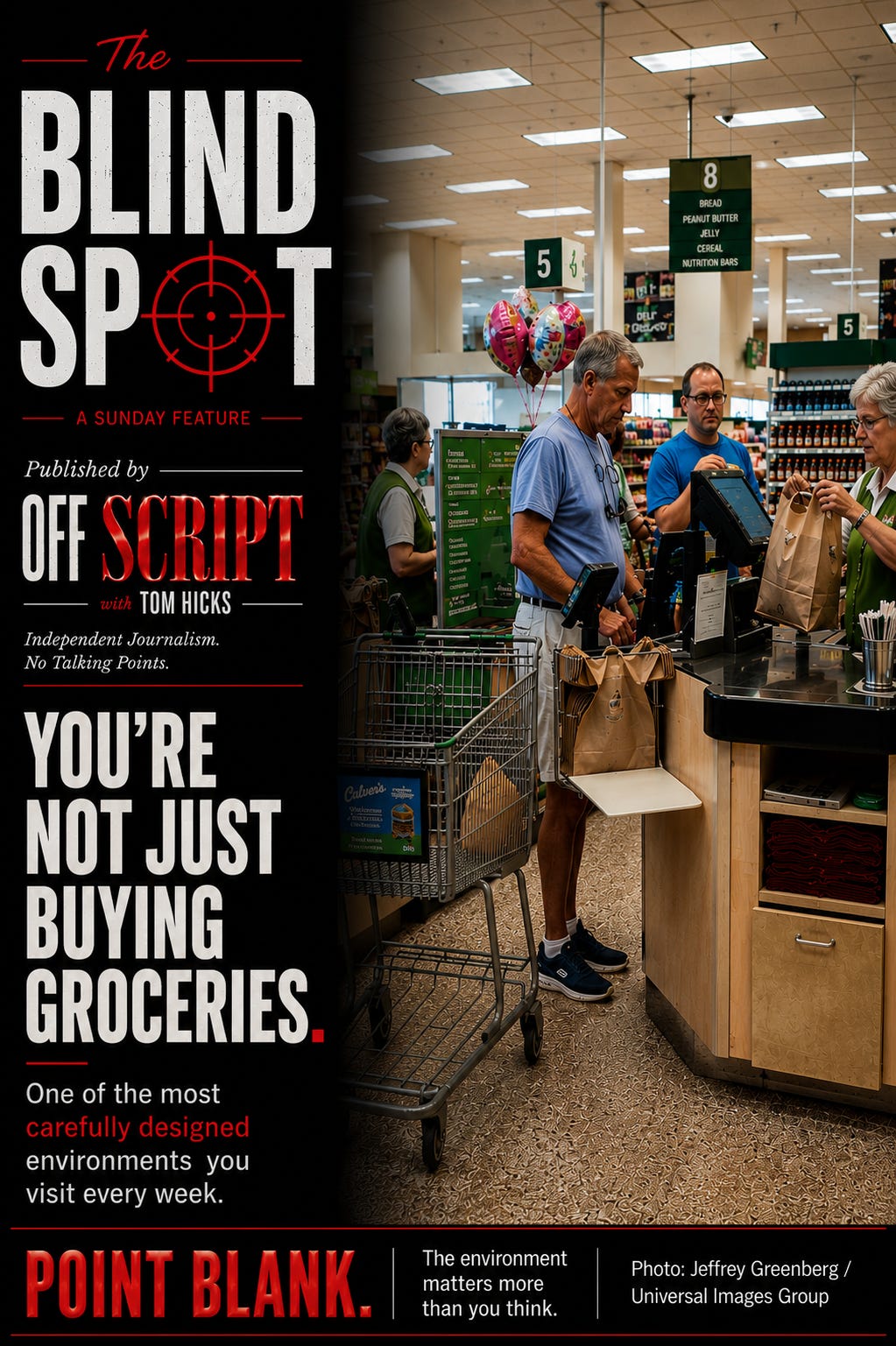
I went to the grocery store because I needed tea bags.
Well...tea bags, eggs, and cat food. That was the list, anyway. Twenty-five minutes later I was standing in the checkout line with strawberries, tortilla chips, smoked Gouda, barbecue sauce, and a package of cookies I don’t remember making a conscious decision to buy. I wasn’t even annoyed. Hell, by then I’d already convinced myself the Gouda was going to make a pretty respectable grilled cheese sandwich.
About halfway through the trip, I caught myself doing what I suspect most of us do. Every extra item came with its own little defense attorney. The strawberries looked great. The chips would go with sandwiches. The barbecue sauce was on sale. One purchase after another got explained, justified, and quietly added to the pile until I looked down at the cart and thought, For fuck’s sake, Tom...you came in here for tea bags.
Standing there waiting to pay, I did what I’ve always done. I blamed myself. I should’ve had more discipline. I should’ve stuck to the list. I should’ve walked right past the damn cheese.
Then it occurred to me that maybe I’d been asking the wrong question all these years.
If this happened once in a blue moon, who cares? Chalk it up to a weak moment and move on. But this isn’t something that happens once in a while. It happens every day, in grocery stores all over the country, to people who swear they weren’t planning to buy half the stuff they brought home. At some point you have to wonder if there’s more going on than a nationwide shortage of self-control.
Most of us have heard the old story about milk being in the back of the store. Supposedly it’s there to make you walk past everything else before you get to it. There’s some truth to that, but it’s also one of those stories that’s become so familiar we stopped asking whether it tells the whole story.
It doesn’t.
In fact, I think it sends us looking in the wrong direction.
We love the idea that there’s one big trick. One secret somebody finally uncovered. One clever piece of psychology that’s been separating us from our money all these years. That’s how headlines get written, but it isn’t how grocery stores actually work.
The truth is a hell of a lot more ordinary.
And that’s exactly why it works.
Nobody running a grocery chain wakes up in the morning wondering how to hypnotize customers into buying potato chips. They want people to enjoy shopping there, find what they need, notice a few things they didn’t realize they wanted, and come back next week. So they study shoppers. They watch how people move through the store. Universities study the same questions from the academic side. Marketing researchers publish the results. Retailers test those ideas in the real world. Over time, the approaches that consistently work become standard practice.
That’s not a conspiracy.
That’s Tuesday.
The funny part is that the internet managed to make the real story less believable than the fake one. Spend ten minutes online, and you’ll run into claims about grocery stores pumping artificial bakery smells through the ventilation system or using hidden psychological blueprints to control your mind. Some retailers have experimented with scent marketing over the years, but a lot of the folklore floating around online falls apart once you start reading the research instead of the memes.
The documented evidence tells a different story, and honestly, I think it’s much more interesting.
The grocery store doesn’t have to make you buy something you don’t want.
It just has to make one choice a little easier than another.
That sounds like a tiny difference until you realize your average shopping trip isn’t one decision. It’s dozens of them. Sometimes hundreds. Every aisle asks a question. Which pasta sauce? Which cereal? Do we need coffee filters? Are we almost out of mustard? Is that actually a good price, or does it just look like one? By the time you’ve been through half the store, your brain has made more little decisions than you can remember, and that’s before you ever get to the checkout lane.
That’s when I stumbled across a piece of research that made me laugh out loud.
Not because it was funny.
Because it was so damn simple.
Researchers discovered that the size of the shopping cart changes how people buy. The prices don’t change. The products don’t change. The shopper doesn’t change. The only thing that’s different is the size of the cart rolling through the store. Larger carts make the same amount of groceries look like less, and people tend to buy more as a result. Studies in retailing and consumer behavior have repeatedly found that seemingly minor environmental cues, including basket and cart size, influence purchasing decisions in measurable ways.
I had to stop reading for a minute.
Think about what that means.
You walk into the store with the same shopping list, the same budget, the same refrigerator waiting at home, and probably the same promise you made to yourself not to spend a fortune this week. None of that changes.
The cart does.
And somehow that’s enough to nudge the odds.
Not guarantee anything or force anything. It just quietly changes the odds in a direction that happens to be very good for business.
Once I got my head around that, I started looking at the rest of the store differently, and that’s when things got really interesting. The next time I went to the grocery store, I left my shopping list folded in my pocket.
Not because I wasn’t going to use it. I wanted to see the store before I started seeing products.
It’s amazing what jumps out at you when you stop thinking about dinner.
I found myself standing in front of the pasta sauce, and instead of reading labels, I started looking at where the labels were. There was the national brand sitting exactly where my eyes landed. Another familiar brand was right beside it. The cheaper store brand wasn’t hidden, but it wasn’t exactly introducing itself either. It sat lower on the shelf, just far enough out of my natural line of sight that I had to bend over before I really considered it.
Well, son of a bitch. I’d spent years telling myself I carefully compared my options. The truth was I was mostly comparing the options somebody had made the easiest to notice.
There’s an old saying in retail: “Eye level is buy level.” I always assumed that was just a catchy phrase managers used in meetings. It turns out there’s a lot of evidence behind it. Shelf space has measurable value because human attention has measurable value. Manufacturers routinely pay retailers for premium placement, and products sitting where shoppers naturally look receive more attention than products placed higher or lower on the shelf.
Notice what that doesn’t mean.
It doesn’t mean the expensive brand is automatically better, and it doesn’t mean the cheaper brand is automatically better. It means your first decision often isn’t which product to buy. It’s which products make it into your field of view in the first place.
That struck me because we spend a lot of time congratulating ourselves for making informed choices. We compare ingredients, check prices, read nutrition labels, and convince ourselves we’re evaluating every option. In reality, some options are getting a head start before we ever begin comparing anything.
Then there are those displays sitting at the ends of the aisles.
If you’re like me, you’ve probably assumed they were there because whatever’s on them must be a bargain. Sometimes it is. Sometimes it’s a seasonal promotion. Sometimes it’s a manufacturer’s newest product. And sometimes the company whose name is on that display paid good money to put it exactly where you’re guaranteed to notice it.
Those displays are called end caps, and they’re some of the most valuable real estate in the building. Study after study has found that simply moving a product to an end cap can produce a significant increase in sales, even when the price stays exactly the same. People buy more because more people actually see it.
That’s when the whole thing started clicking for me. I’d been imagining grocery stores looking for one brilliant psychological trick. That’s not how this works.
They’re looking for hundreds of little advantages.
A shelf here.
A display there.
A slightly easier path through the store.
A little more visibility.
A little more time.
None of those changes sounds particularly impressive by itself. Put enough of them together, though, and they begin nudging millions of shopping trips in the same direction.
And then I got to the music.
Honestly, I couldn’t have told you what was playing the last ten times I went grocery shopping. If you’d asked me while I was standing in the produce department, I probably would’ve shrugged and said, “I don’t know...music.”
That’s exactly why the research fascinated me.
One of the classic studies in retail marketing found that shoppers exposed to slower-tempo background music moved more slowly through supermarkets, and those slower shopping trips were associated with higher sales. Later studies have refined the picture, but the central idea has remained remarkably consistent: changing the pace of the environment changes the pace of the shopper.
Think about what that actually means.
The music isn’t trying to convince you to buy tomato soup.
It’s giving the tomato soup another thirty seconds to catch your eye.
The more I read, the less interested I became in individual tricks.
I was beginning to see the grocery store as a carefully studied environment, where dozens of small, well-documented decisions quietly worked together.
That’s a lot more interesting than any conspiracy theory.
Before We Go Any Further...
Blind Spot is one of my favorite things to write because it permits me to slow down.
No breaking news. No screaming headlines. Just one ordinary part of life that deserves a closer look. Sometimes the biggest stories aren’t hidden because somebody buried them. They’re hidden because we’ve walked past them so many times that we stopped seeing them.
If you enjoy this kind of evidence-first deep dive, becoming a paid subscriber unlocks the rest of today’s Blind Spot, every future Blind Spot, and the complete subscriber archive.
I’d love to have you along.
🔒 Paid Subscriber Content Below
🔒 Paid Subscriber Content
The more I dug into this, the more I realized the grocery store wasn’t really the story anymore.
It was just the place where I finally noticed something that’s probably been happening around me my entire adult life. I went into this thinking I’d find one clever retail trick that explained why so many of us come home with more than we intended to buy. Instead, I kept finding dozens of small studies, each examining one tiny piece of the experience. One researcher looked at shopping carts. Another looked at shelf placement. Somebody else studied music, or lighting, or checkout lanes, or the way people move through a store. At first it felt frustrating because nobody seemed to have *the* answer. Then I realized they all did.
That’s the part I think we’ve gotten backwards.
We keep asking, “What’s the trick?” as if somebody in a corporate office discovered one magical way to separate us from our money. The evidence says that’s not how this works. The grocery store isn’t built around one brilliant insight. It’s built around hundreds of ordinary ones. Each of them is almost too small to notice. Each of them nudges the odds ever so slightly. By themselves they don’t amount to much, but together they create an environment that’s been refined over decades by watching how real people actually shop.
The football fan in me couldn’t help seeing the parallel. Nobody wins consistently by throwing Hail Mary passes. Coaches win because they understand that a game is usually decided by a hundred little things that don’t make the highlight reel. A block that springs a six-yard run. A receiver who picks up an extra two yards after contact. A quarterback who takes the check-down instead of forcing the deep ball. You stack enough of those small successes together, and suddenly you’ve driven eighty yards without ever making a spectacular play.
That’s what finally changed the way I look at a grocery store.
The shopping cart isn’t trying to trick me. The music isn’t trying to trick me. The produce department isn’t trying to trick me, and neither is the candy sitting next to the register. Looking at each one individually is like trying to explain a football game by talking about one third-down conversion. It mattered, but only because it was part of everything else that happened.
Take the produce department. For years I’d accepted the explanation that it’s at the front because fresh fruits and vegetables make the store look inviting. That’s true, but it isn’t the whole story. Consumer researchers have also explored whether beginning your trip with healthier choices influences the way you think about the rest of your shopping. The evidence isn’t conclusive in every circumstance, but it’s compelling enough that researchers continue to study it. One design choice can make the store feel fresh, reinforce its brand, encourage produce sales, and subtly influence later decisions all at the same time. That’s a pretty good return on one display of apples.
Then you get to the checkout lane, and suddenly all those little decisions you’ve been making for the last forty minutes have caught up with you. You’ve compared prices, read labels, debated brands, remembered something you forgot to put on the list, and probably talked yourself into at least one purchase you weren’t expecting to make. Now you’re standing there with nothing to do but wait, surrounded by candy, gum, chocolate, and cold drinks. Researchers still debate exactly how decision fatigue works, but retailers have understood for a very long time that checkout is one last opportunity for an impulse purchase before you head home.
None of this means grocery stores are evil, and it certainly doesn’t mean we’re helpless. In fact, I think that’s one of the biggest mistakes people make whenever this topic comes up. We seem to think we have to choose between two extremes. Either we’re completely rational shoppers making every decision in a vacuum, or we’re victims being manipulated every time we reach for a box of crackers.
Real life is usually a lot less dramatic than that.
We’re responsible for what goes into our carts. At the same time, we’re making those decisions inside an environment that’s been studied, tested, measured, adjusted, and refined by people whose careers revolve around understanding how customers behave. Those two ideas don’t cancel each other out. If anything, they complement each other. Understanding the environment doesn’t take away your responsibility. It just helps explain why sticking to that shopping list sometimes feels harder than it ought to.
And once that thought settled in, I couldn’t keep it confined to the grocery store.
You start noticing the same pattern everywhere. Streaming services don’t autoplay the next episode by accident. Social media doesn’t refresh forever because somebody forgot to put an end on the page. Casinos don’t just happen to be missing clocks. Airports, museums, restaurants, websites, sports stadiums, and grocery stores all have one thing in common. They’re environments designed by people who spend an awful lot of time thinking about how the rest of us move, pause, notice, decide, and occasionally change our minds.
That’s why I think this story stayed with me.
I still bought the smoked Gouda.
I wasn’t hypnotized. I wasn’t manipulated. I wasn’t the victim of some secret corporate mind-control program. I was just a human being making decisions inside one of the most carefully studied environments I visit every week. Once I understood that, I stopped asking whether the grocery store was trying to outsmart me.
I started asking a much better question.
Where else have I mistaken careful design for coincidence?
That’s the Blind Spot.
One Question Before You Go
What’s one ordinary place you’ve stopped noticing?
Not the places we expect to influence us. The everyday ones. The grocery store. The airport. The doctor’s waiting room. Your favorite streaming service. The gas station. The coffee shop.
Pick one and spend ten minutes paying attention instead of just passing through it.
You might be surprised by how much thought has already gone into the decisions you think you’re making all by yourself.
More from Tom Hicks Media
If you liked slowing down long enough to notice what everyone else walks past, there’s more where this came from.
Off Script with Tom Hicks tackles the stories behind the headlines, separating evidence from noise. Panic Room Sports brings that same evidence-first approach to the NFL, where conventional wisdom isn’t always the same thing as good analysis. Tom’s Number Ones takes a daily trip through Billboard history, one chart at a time, while Lotus Purrspective reminds us that humans have a remarkable talent for making simple things unnecessarily complicated.
All are free to subscribe.
THE RECORD
What the evidence actually shows.
Before we wander off muttering about mind control and evil grocery stores, here’s what the evidence actually supports.
Larger shopping carts have been associated with larger average purchases in multiple retail studies.
Products placed at eye level generally receive more attention than products placed higher or lower on the shelf.
End-cap displays consistently outperform ordinary shelf placement, even when prices don’t change.
Slower-tempo background music has been associated with shoppers spending more time in supermarkets and, in many studies, spending more money.
Checkout lanes are intentionally designed to encourage impulse purchases during the final stage of a shopping trip.
None of this research concludes that shoppers lose free will or are incapable of making informed decisions. The evidence supports the idea that environments influence behavior, not that they determine it.
The Bullshit Detector™
Claim: Grocery stores have discovered secret psychological tricks that force you to buy things you don’t want.
Verdict: Mostly Bullshit.
The research is both less dramatic and more persuasive than that.
There isn’t one hidden trick. There isn’t one piece of retail wizardry that suddenly makes sensible people fill a cart with things they never intended to buy. What decades of behavioral research actually show is something much simpler. Small environmental changes influence small decisions, and those small decisions add up over the course of a shopping trip.
That’s an important distinction because it keeps us away from two equally unhelpful conclusions.
The first is that we’re helpless victims being manipulated every time we walk through the automatic doors.
The second is that every shopping decision happens in a vacuum and our surroundings don’t matter at all.
The evidence supports neither position.
We’re still responsible for what goes into our carts. At the same time, we’d be kidding ourselves if we pretended the environment didn’t matter. Grocery stores spend millions of dollars studying customer behavior because those investments consistently pay for themselves. That’s not a conspiracy. It’s good business.
Maybe the real lesson isn’t about grocery stores at all.
Maybe it’s that we should pay a little more attention to the environments we move through every day. The people who designed them certainly did.Like the Bullshit Detector?
The Off Script Bullshit Detector is now available as a downloadable reference guide.
Whether you’re reading the news, listening to politicians, scrolling social media, or arguing with your weird uncle at Thanksgiving, it walks you through the same evidence-first framework I use in Off Script to separate facts from manipulation.
Free for Off Script subscribers. $4.95 for everyone else.
Available now in the Tom Hicks Media Store
☕ Buy Me a Cup of Tea
If you enjoyed today’s Blind Spot, consider buying me a cup of tea.
These Sunday deep dives take considerably longer to research than they do to read. I don’t mind the work. In fact, it’s my favorite part of the job. Reader support gives me the time to keep chasing interesting questions instead of chasing clicks, and it helps keep Off Script independent.
Thank you for reading, for subscribing, and for spending part of your Sunday with me.
See you tomorrow morning for another edition of Off Script with Tom Hicks.
#OffScriptWithTomHicks #BlindSpot #ConsumerPsychology #BehavioralScience #Retail #GroceryStores #CriticalThinking #MediaLiteracy #EvidenceMatters #TomHicksMedia
Again, another well written piece. My favorite grocery shopping happens at Trader Joe's. And I always come away with expected unexpected purchases. That is the fun part! And I adore the staff! ❣️