

I’ve been thinking about trust lately. Not because I suddenly woke up one morning and decided to become America’s relationship counselor. But every time a new study drops showing institutional trust still sliding, I find myself less interested in the numbers and more interested in what the hell we think is going to replace what we’re losing.
Every time I see one, the same explanation gets dragged out of storage.
America is polarized. America is divided. America is splitting into two camps.
Maybe.
But the more I look around, the less convinced I am that’s actually what’s happening.
The popular story says we’re becoming two countries occupying the same map. Republicans over here. Democrats over there. Conservatives in one corner. Liberals in the other. Everybody yelling. Nobody listening.
It’s a clean story. It’s simple. It’s easy to understand.
It’s also starting to feel like it’s missing a hell of a lot of what the fuck is actually happening.
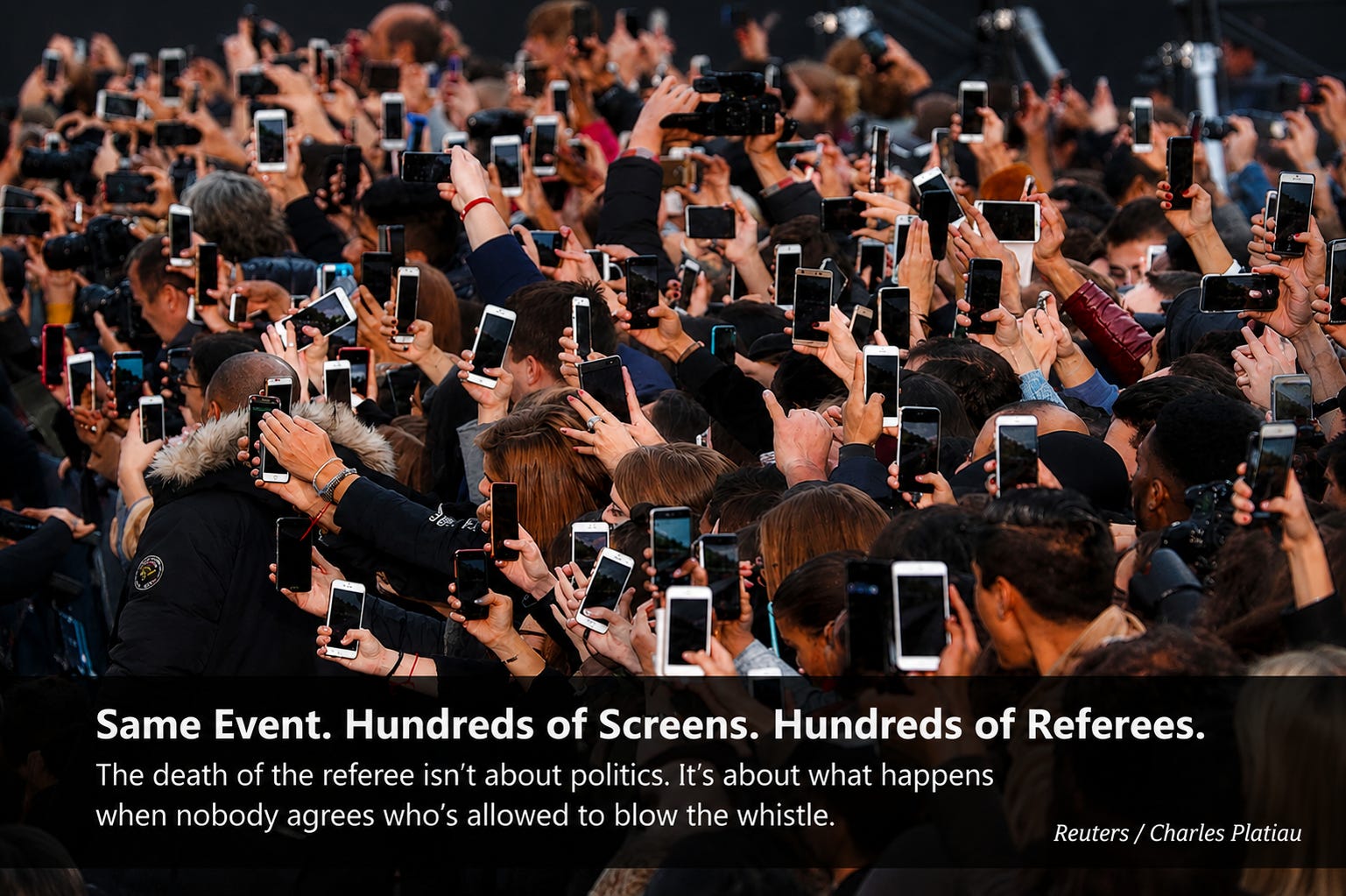
Because when I look around, I don’t see two camps. I see hundreds.
I see people who trust traditional newspapers. I see people who trust independent journalists. I see people who trust YouTube channels, podcasters, church leaders, local community groups, family members, social media feeds, online forums, and neighborhood Facebook pages. I see people who trust experts. I see people who trust nobody claiming to be an expert. I see people who have reached the point where they barely trust anybody at all.
That’s not a two-sided divide. That’s fragmentation.
And I think we’re spending so much time talking about polarization that we’re missing something potentially more important.
We’re watching the death of the referee.
For most of my life, Americans have argued constantly. If you’ve ever attended a family holiday dinner, worked in an office, sat in a bar, listened to sports talk radio, or spent ten minutes on the internet, you already know that disagreement is hardly a new development. Americans have been arguing with each other since the country was assembled out of spare parts and optimism.
What made those arguments different was that most people still accepted the existence of certain referees.
They didn’t necessarily like them. They didn’t always trust them. Sometimes they had perfectly legitimate reasons not to. But there were still institutions that broadly functioned as scorekeepers. Courts. Local newspapers. Universities. Scientific organizations. Election systems. Government agencies. Professional associations. National media outlets. Not perfect institutions. Not infallible institutions. But institutions that occupied a shared space in the public mind.
When a dispute happened, people could at least agree where to look for the ruling.
Today, we’re increasingly arguing about the ruling, the referee, the rulebook, the field, and whether the game itself exists.
That’s a very different problem.
Before anybody starts composing an angry email explaining exactly why one institution or another deserves every ounce of distrust it has received, let me save you the trouble.
Maybe you’re right.
Some institutions absolutely damaged their own credibility. Some made catastrophic mistakes. Some became arrogant. Some became politicized. Some became victims of political attacks. Some experienced all of the above simultaneously.
That’s an important conversation.
It’s just not the conversation I’m having today.
Regardless of why trust declined, the evidence suggests it has declined. That’s the part that’s actually in the record.
The thing that fascinates me is what rushed in to fill the space.
Nature hates a vacuum, and apparently so does human society. The moment people stop trusting large institutions, they don’t suddenly become perfectly independent thinkers floating through the universe gathering facts like some kind of enlightened information Jedi. They find something else to trust.
Sometimes that’s a church. Sometimes it’s a favorite journalist. Sometimes it’s a podcast host, a YouTube channel, a Substack writer, or a community organization. Sometimes it’s a group chat with six friends whose combined qualifications consist primarily of having strong opinions and unlimited access to Wi-Fi.
The point isn’t whether those alternatives are good or bad. The point is that they exist.
People still need ways to determine what’s true. They still need sources. They still need filters. They still need somebody to help them sort signal from noise. Human beings don’t stop looking for trust. They just move it somewhere else.
Join us every morning.
Most of the national discussion treats collapsing trust like it’s the whole damn story. Trust falls. Poll numbers drop. Everybody nods gravely and writes another article about institutional confidence.
Fine.
But that’s only half the story.
The thing that keeps nagging at me is what comes next. People don’t wake up one morning and decide they don’t trust anything anymore. That’s not how human beings work. We’re trust-seeking little bastards. If we stop trusting one thing, we immediately go looking for something else to trust.
The trust doesn’t disappear.
It relocates.
If a local newspaper closes, people don’t stop looking for information about what’s happening in town. They find another source. If confidence in a government agency drops, people don’t suddenly stop caring about the issue that agency handles. They look elsewhere for guidance. If faith in traditional media weakens, audiences don’t spend their evenings staring silently at blank walls. They replace one information source with another.
The replacement system is already under construction, regardless of opinions. Hell, we’re living inside it. We built the damn thing while arguing about whether it existed.
Some of it is healthy. Some of it is innovative. Some of it gives a voice to people who never would have been heard under the old system. Independent journalism exists because of this shift. The Unredacted Bastard exists because technology made it possible to bypass traditional gatekeepers and talk directly to readers.
That’s one of the upsides.
The downside is that every replacement system eventually develops its own incentives, biases, blind spots, and bullshit.
The old referees had flaws. Lord knows they had flaws. Some of them screwed up so badly they practically handed their critics a loaded cannon and a map. But one advantage of having broadly recognized institutions is that large numbers of people could at least agree where disagreements were supposed to be resolved.
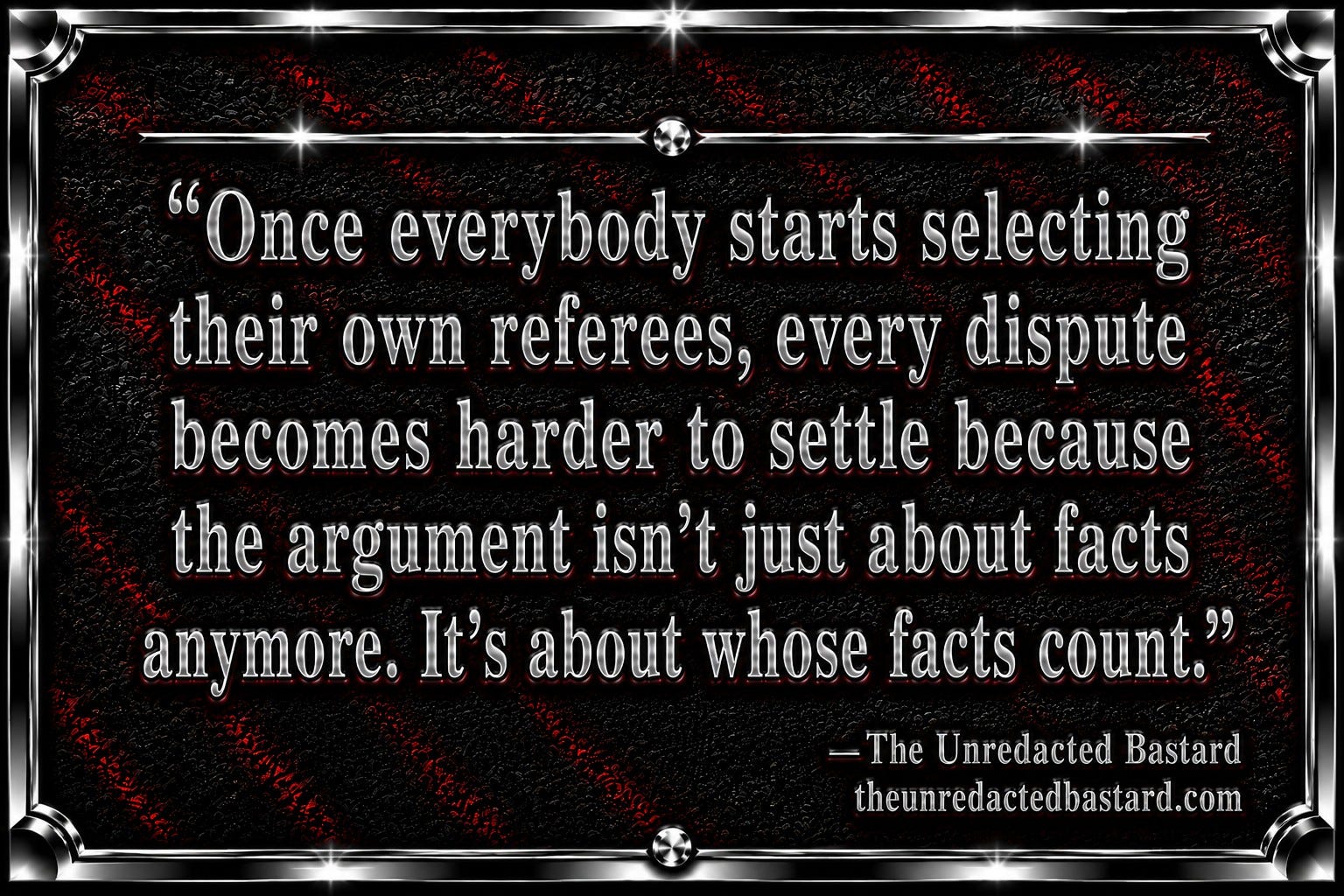
Once everybody starts selecting their own referees, every dispute becomes harder to settle because the argument isn’t just about facts anymore.
It’s about whose facts count.
You’ve probably had one of these conversations lately. I know I have.
Somebody sends you an article.
You don’t trust the source.
You send one back.
They don’t trust that source.
Twenty minutes later, nobody has learned a damn thing because you’re still arguing about which referee gets to make the call.
You can argue with somebody about a set of facts and eventually reach some kind of conclusion. It’s a hell of a lot harder to reach a conclusion when both sides reject the legitimacy of each other’s sources before the conversation even starts. At that point, you’re not having a debate. You’re having two entirely separate conversations occupying the same airspace.
And this doesn’t just affect politics.
It affects weather warnings, public health guidance, local government, school board meetings, consumer fraud, scientific research, crime reporting, election administration, and emergency management. In other words, it affects the stuff that actually matters when life stops being theoretical. Whether the water is safe to drink. Whether people evacuate before a hurricane. Whether they trust election results. Whether they recognize a scam before it empties their bank account.
The consequences stop being theoretical pretty damn quickly.
Now throw artificial intelligence into the mix. As if the internet wasn’t already chaotic enough, we’re entering an era where convincing fake images, fake audio, fake videos, and entirely fabricated news stories can be generated in minutes. The information environment was already a dumpster fire rolling downhill. Now we’re teaching the dumpster how to manufacture its own flames.
That doesn’t mean every institution suddenly deserves blind trust. It doesn’t mean every independent source is automatically wrong. It doesn’t mean we should all crawl back to the information systems of twenty years ago and pretend they were flawless. What it means is that figuring out what’s real is becoming harder, not easier, and we’re entering that environment at exactly the moment when Americans are increasingly operating from completely different trust networks.
Maybe the funniest part of this whole mess is that everybody is absolutely convinced somebody else is causing it.
Spend ten minutes online, and you’ll see it. The media blames social media. Social media blames the media. The government blames misinformation. Citizens blame the government. Experts blame politics. Politicians blame experts.
Everybody’s standing in the middle of a five-alarm fire, pointing at somebody else’s fucking match.
Meanwhile, the floor is collapsing beneath all of them.
The reality is that trust didn’t pack its bags and leave town. It just got chopped into a thousand little pieces and scattered across the internet like somebody fed the social contract into a wood chipper.
That’s not automatically good.
It’s not automatically bad.
But it is happening.
The question is whether a country can continue functioning when every community, every ideological group, every information network, and every online tribe starts carrying around a different rulebook. Countries survive disagreements all the time. Hell, disagreement is practically America’s favorite hobby. What countries struggle to survive is the loss of shared referees.
And here’s the part that keeps setting off alarm bells in my head.
We’re not at the bottom of this yet.
The tools for manufacturing reality are getting cheaper, faster, and better. The tools for sorting reality from bullshit aren’t keeping pace. Every year it gets easier to create convincing lies and harder to agree on who gets to call them lies.
That’s a hell of a combination, and I don’t think we’ve fully wrapped our heads around it yet.
Before long, everybody is playing a different game while insisting they’re still on the same field.
But none of that changes the question sitting in the middle of this entire conversation: What happens when nobody agrees who’s allowed to blow the whistle?
Countries don’t stop functioning because people disagree. Hell, disagreement is practically America’s official pastime. We’ve been arguing with each other since the place was held together with wooden ships and optimism. The problem starts when nobody agrees who’s keeping score.
Once that happens, every argument becomes harder to resolve. Every controversy becomes more permanent. Every fact becomes more negotiable. Before long, the loudest asshole in the room starts declaring victory while half the country insists the game never happened, and the other half is still arguing about the rulebook.
History suggests that’s not where the trouble ends.
It’s where it starts.
UPGRADE TO PAID
If you value independent journalism that follows the evidence wherever it leads, consider upgrading to a paid subscription.
Paid subscribers help keep The Unredacted Bastard independent, uncensored, and gloriously difficult for powerful people to ignore.
FROM THE OTHER SIDE OF THE HOUSE
For a completely different perspective on human behavior, check out Lotus Purrspective. Somebody has to monitor the species while I’m busy yelling about it.
LIKE • SHARE • SUBSCRIBE
If this piece made you think, laugh, swear, or send it to somebody who immediately disagreed with it, hit like, share it around, and subscribe.
BUY ME A TEA: Keeping an eye on democracy is thirsty work.
#TheUnredactedBastard #IndependentJournalism #MediaTrust #TrustInInstitutions #Journalism #Democracy #Politics #PublicTrust #InformationAge #CivicLife
The fragmentation of society by destruction of trust... in this case trust representing the foundations of societies reality. I have always been a chaos theorist and this fits in nicely with my fragmented trust issues.